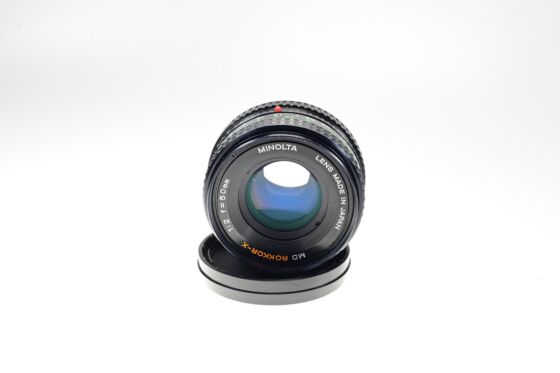
Short story about Minolta 50mm f2.0 lens. Let's clear something up first, because the classifier got a little excited: this isn't M42 screw-mount glass. It's Minolta's own SR/MD bayonet mount, the system Minolta built and refined entirely in-house rather than adopting the universal Pentax screw thread everyone else was using. That distinction matters to collectors — it's part of why Minolta glass developed its own devoted following instead of just being interchangeable commodity glass.
The name on the barrel has its own story. Minolta's lenses were branded "Rokkor" starting in 1940, a name founder Kazuo Tashima chose after Mount Rokkō, the peak visible from the company's optical works near Osaka — he reportedly wanted a name that would symbolize high-quality optics, and the brand stuck around for four decades before Minolta phased it out in a corporate rebrand around 1981. The loyalty it built was real: when Minolta briefly sold lenses without the Rokkor name in the late '70s, customers actually asked dealers where their "Rokkor cameras" had gone.
The "X" is its own footnote. It has nothing to do with any optical formula — it marks lenses built for the North American market starting with Minolta's X-series cameras (the XK/X-1) in the early 1970s, when Minolta began engraving an orange "X" onto US-bound lenses specifically to make gray-market imports easier to spot and choke off. Everywhere else in the world, the identical glass was stamped simply "Rokkor." So a Rokkor-X isn't a special edition — it's the same lens with an import stamp, though that stamp is exactly the kind of detail collectors now hunt for.
As for the lens itself: this 50mm f/2 sat one rung below Minolta's faster 50mm siblings (the f/1.7, f/1.4, and the exotic f/1.2) in the standardized four-tier lineup Minolta settled on once it moved all its standard primes to 50mm starting in 1973. It's a simple, honest design — six elements in five groups, all-metal construction — built as the budget option for photographers who didn't need the speed or expense of the faster glass. Minolta was already ahead of much of the industry in producing its own optical glass and shaping its own multi-coatings in-house, which is a big part of why even the "cheap" 50mm in the lineup punched well above its price class in sharpness and contrast. The mount itself evolved in four backward-compatible stages — SR in 1958, MC in 1966, MD in 1977 — meaning a lens like this one will physically mount on nearly any Minolta manual SLR body from across a 40-year span, a rarity that spared Minolta shooters the mount-compatibility headaches that plagued some Nikon and Pentax users.
There's no verified famous-photographer provenance to hang on this specific lens, and I won't pretend otherwise — the closest thing to celebrity in Minolta's lineage is its manufacturing partnership with Leitz on the Leica CL rangefinder, which earned Minolta a reputation in some circles as the "poor man's Leica." What this 50/2 actually has going for it is humbler and, honestly, more useful: it was always the affordable, dependable choice, built with more optical care than its price tag suggested. At $24.47 today, it's still doing exactly the same job it always did.