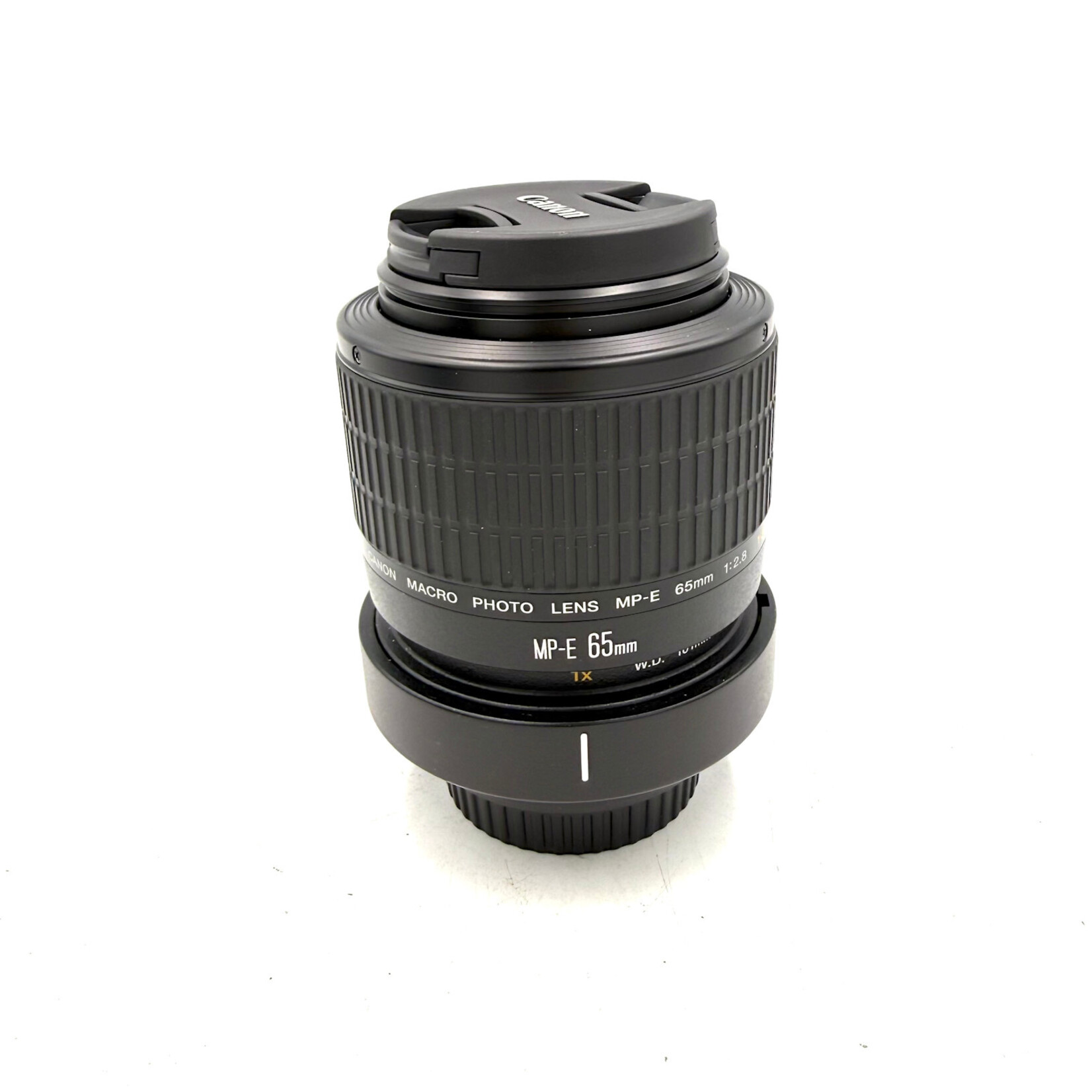
Set the aperture ring on a Canon MP-E 65mm to f/16 and shoot at maximum magnification, and the number on the barrel is fiction. The real light-gathering value works out closer to f/96, roughly four stops darker than advertised. Canon printed the correction in the manual: effective f-number equals the marked f-number multiplied by magnification plus one. At 1x magnification, an aperture of f/2.8 behaves like f/5.6. The lens's own exposure readout, calibrated for a focus distance the lens can never reach, is quietly describing a different lens than the one in your hands.
That's because the MP-E 65mm doesn't do the one thing every other lens is built around: focus on something far away. It can't. Point it at anything beyond a few inches and there's nothing there. It was designed exclusively to work between life-size, 1:1, and five times life-size, 5:1, a range where, as Canon's own literature put it, you can fill a full frame with a grain of rice. There's no autofocus, no motor, and the focus ring most photographers reach for out of habit isn't a focus ring at all. Turn it and you change magnification. To actually focus, you rock your whole body, or your tripod, back and forth until the plane lands where you want it. Working distance at 5x drops to around 41mm, close enough that the front element practically brushes the subject, which is why the lens accepts flash brackets instead of filters for most serious use.
Every one of those limits was a deliberate trade. Before 1999, this kind of magnification meant bellows: reversed lenses, extension tubes, rigs one macro photographer later called Rube Goldberg contraptions, built one shot at a time in a studio, difficult to carry into a garden after a beetle. Canon collapsed all of that into a single twist-ring barrel with a floating optical system and a UD-glass element to keep the color from falling apart at extreme reproduction ratios. The cost of that convenience was total specialization. It does nothing else. It was never meant to.
What's strange is how well the trade paid off. Among insect and small-invertebrate photographers, the MP-E became close to the default. One entomologist blogging in the lens's first decade noted that nearly every professional insect photographer he knew owned one, and that some photographers had switched brands entirely just to use it. Two decades later, on a Canon forum thread announcing its discontinuation, a longtime owner said almost exactly the same thing about himself: the lens was the reason he'd switched to Canon in the first place.
Canon quietly discontinued it in November 2022, after twenty-three years without a direct successor. The company's current native RF macro lens, the RF 100mm F2.8L Macro IS USM, pushes to 1.4x magnification with the help of its spherical-aberration control ring, still a fraction of what the MP-E did on its worst day. Nobody, including Canon, has built anything since that reaches 5x in one barrel without bellows or stacked accessories.
So the lens that couldn't see across a room, that lied about its own aperture and made you learn a new way of focusing entirely, ended up being the reason some photographers picked their camera system in the first place. It's been out of production for four years now, and nothing has come along to make owning one feel dated.