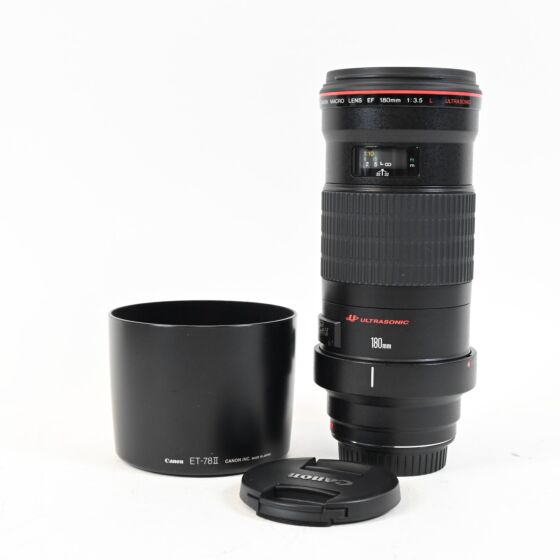
Put the spec sheets side by side and there is no contest. Canon's EF 100mm f/2.8L Macro IS USM is lighter, less expensive, focuses faster, opens wider, and comes with the company's hybrid image stabilization built in. The 180mm f/3.5L Macro USM has none of that. It is heavier, slower to autofocus, a stop and a third darker, has no stabilization at all, and even at launch cost noticeably more.
One reviewer laid out the dilemma about as plainly as it gets: "So, which macro lens should you choose? Good question." And plenty of buyers, reading the numbers, choose the 100mm. It is the sensible answer.
But ask someone who spends their weekends crouched in wet grass photographing dragonflies and jumping spiders, and the sensible answer stops being the right one. The advantage the 180mm has is not on any comparison chart most people read first: distance. At 1:1 magnification, the 100mm puts your lens hood within a few inches of the subject. The 180mm buys you roughly nine and a half inches of working distance at the same magnification, which is the difference between photographing a dragonfly and watching it leave.
One outdoor photography blog, comparing the two lenses at length, conceded every practical advantage to the 100mm — smaller, lighter, cheaper, faster, stabilized — and still recommended the 180mm for nature and insect work, citing that working distance and the way the longer focal length compresses backgrounds into something cleaner and less distracting. A macro photography forum thread makes a similar case less formally: longtime users of both lenses often cite the 180's working distance and tighter perspective as the deciding factor.
The lens was built to make that trade possible. Three ultra-low dispersion elements and a floating internal focus group hold the optical formula together from infinity down to life-size, and because the front element neither extends nor rotates as it focuses, a ring flash or diffuser mounted up front stays exactly where you put it through the whole range. It carries the weather sealing you'd expect of an L lens meant to live in wet undergrowth. Canon has said it about as directly as a manufacturer ever does: this is a lens for close-ups where a long working distance is desirable, on animals that do not sit still for an audience.
Canon discontinued it in 2021, more than two decades after it appeared alongside three other new L lenses at a Las Vegas trade show in 1996. The 100mm remains the lens most people are pointed toward, and correctly so, for flowers, product shots, anything that will not startle. The 180 never tried to win on the merits everyone checks first. It only had to win the one argument that mattered to the people who actually needed it: how close do you have to get.