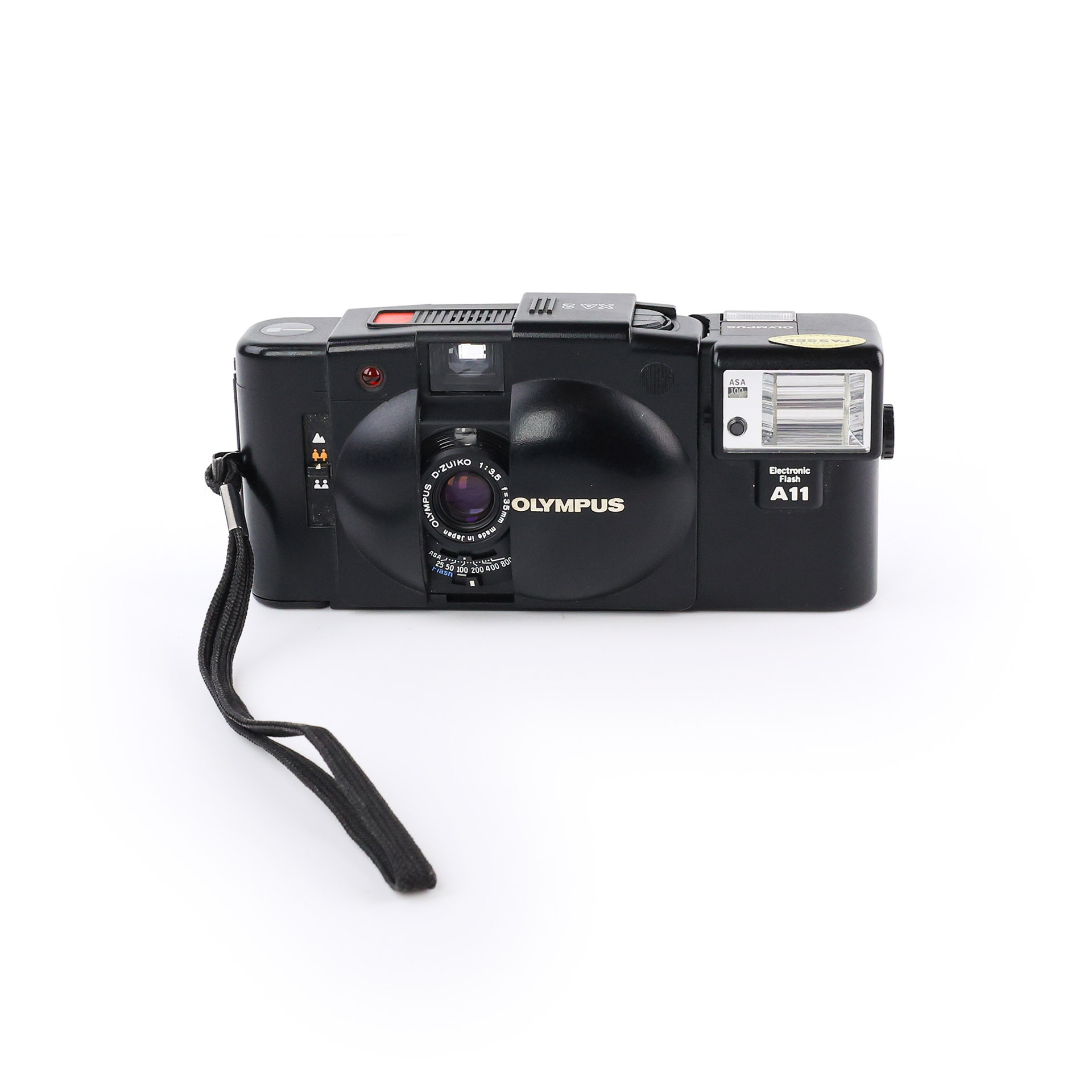
In 1979, Yoshihisa Maitani gave his engineers a number: four centimeters. If the new Olympus compact couldn't come in under that thickness, he told them, the whole project would count as a failure. To hit it, his lens team abandoned a conventional Tessar layout and worked out what Maitani later called a "reverse retrofocus" design, a six-element lens sitting just 33.6 millimeters from the film plane. They then squeezed in a coupled rangefinder with the shortest base of any ever built. The result, the Olympus XA, was one of the smallest true rangefinder cameras ever made, wrapped in a sliding clamshell that doubled as a lens cap and a power switch.
It was also, at around $200 in the summer of 1979, expensive enough that it missed a lot of buyers it might otherwise have won over.
So a year later, Olympus handed that same body to a second team and told them to take out exactly the two things the first team had fought hardest for. Gone was the rangefinder, replaced with a three-position zone-focus lever: close, medium, far. Gone were two of the six lens elements, dropping the aperture from f/2.8 to f/3.5. What came back was the XA2, a plainer, cheaper camera that shared the shell, the clamshell mechanism, and even the clip-on A11 flash unit, but abandoned the one feature that had cost Maitani's team the most sweat.
On paper this reads as a demotion. In practice it turned into something stranger.
Photographers who picked up the XA2 kept noticing the same thing: the zone focus wasn't a compromise so much as a different kind of speed. One longtime reviewer clocked it directly, noting you could fire off three frames with zone focus in the time it takes to find the right line in a rangefinder patch. A street photographer doesn't always want precision. Sometimes they want to raise the camera and shoot before the moment closes, and a lever with three settings beats a viewfinder patch that has to be lined up by eye every single time.
The numbers back up what the anecdotes suggest. The XA2 stayed in production for nearly six years - about as long as the rangefinder flagship it was cut down from - and is widely considered one of the more common surviving models in the series today. By at least one account, its reputation has only grown as prices on its rangefinder-equipped sibling have climbed. The A11 flash bolted to this particular listing isn't some downgraded accessory, either; it's the identical unit Olympus built for the XA, unbothered by which camera it's clipped to.
None of this makes the XA2 better than the XA in any way that shows up on a spec sheet. The lens is slower, the finder is dumber, the control you get over aperture and precise focus is gone entirely. But cameras don't get used on spec sheets. They get used on sidewalks, in bad light, with three seconds to decide whether a shot is worth taking, and on that ground the camera Olympus deliberately made simpler kept winning arguments the more sophisticated one couldn't.
Maitani spent the better part of a decade proving a rangefinder could survive inside a four-centimeter shell. The camera that actually stuck around was the one where somebody, a year later, took it back out.