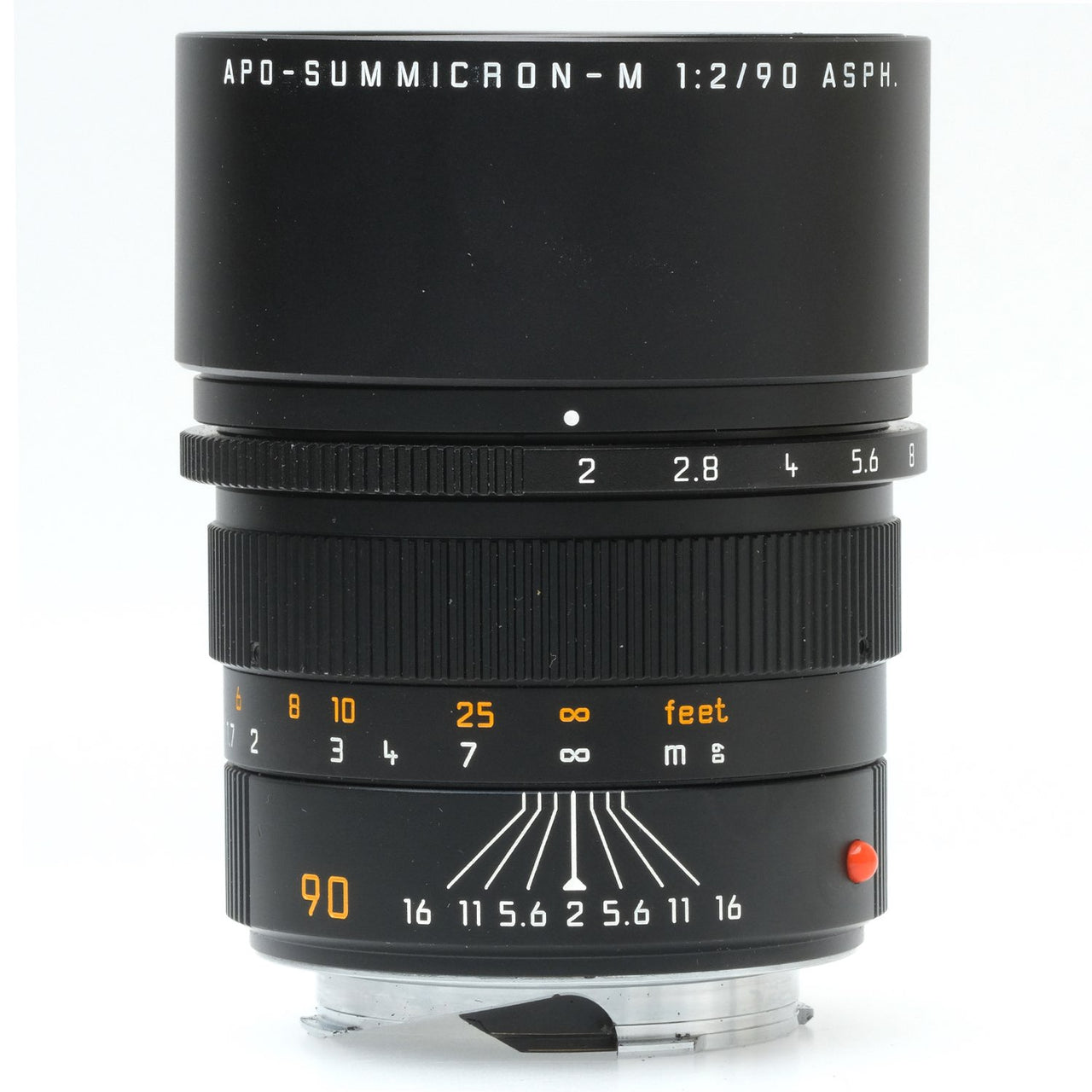
Ninety millimeters has always been the awkward middle child of rangefinder photography. Too long to grab-shoot, too short to feel like a proper telephoto, and brutal to focus accurately through a tiny rangefinder patch. Leica spent decades chipping away at that problem, and the lens in question — the APO-Summicron-M 90mm f/2 ASPH — is where they finally nailed it.
The lineage matters here. Leica's older 90mm f/2 Summicron ran from 1980 to 1998 (non-ASPH, non-APO) in a handful of mechanical variations, all sharing the same optics (5 elements in 4 groups) and an 11-blade aperture, it stops down to f/16 in half-stop clicks. Leica released the new APO-ASPH design in 1998 as its successor, and the upgrade wasn't cosmetic — it was a genuine materials-science leap. This was the first Leica lens to use a polished aspherical element rather than a pressed one, a manufacturing breakthrough that allowed the use of the exotic glass needed for true apochromatic correction. Put plainly: it's a five-element, five-group formula combining one polished asphere, two anomalous-partial-dispersion elements, and two high-refractive-index elements, all working together to all but eliminate color fringing and keep the lens razor-sharp wide open.
Handling one, you feel the engineering choices as much as see them. It's built with an all-metal body, a built-in slide-out hood, and a 55mm filter thread, focusing down to one meter. Unlike its little sibling, the 75mm APO-Summicron, the 90 skips a floating lens element — a deliberate, slightly conservative choice that keeps things simpler but means close-focus performance takes a small back seat. There's one honest quirk worth knowing before you buy: because the aspherical surface was manufactured with an early-generation polishing process, out-of-focus points of light can show noticeable "onion ring" texture — a known, minor signature rather than a defect, and one that only surfaces in fairly specific conditions.
Collectors love this lens partly because Leica has never let it fade quietly into the catalog. Beyond the standard black run, there's a titanium "50 Jahre M-System" edition (just 50 units, September 2004), a 250-unit Safari version (February 2020), a 100-unit Hermès "Jean-Louis Dumas" edition (May 2012), and a 40-unit Historica 40th Anniversary version (July 2015) — the kind of scarcity that keeps M-mount completists checking listings obsessively. Total production across the standard run has reportedly passed 14,820 units since 1998, which sounds like a lot until you remember it's spread across nearly three decades.
Street pricing has swung wildly over the years too — reportedly around $3,500 in 2008, cratering to about $1,800 by 2010, before climbing back into the low thousands through the 2010s — and Leica eventually carried the same optical formula into an autofocus SL-mount version for mirrorless shooters, a sign of how much faith the company still has in the design. Which brings us back to that current $3,195 price tag (Glass Hound find). Against a used market that's reportedly been sitting comfortably north of that for clean examples, and against a lens whose core engineering story — first polished asphere, true APO correction, a genuinely solved 90mm problem — hasn't been matched by many other rangefinder teles since (I'm fact, there is Voigtlander 90 APO, but slightly slower aperture) - this is the rare listing where the deal and the history actually deserve each other.