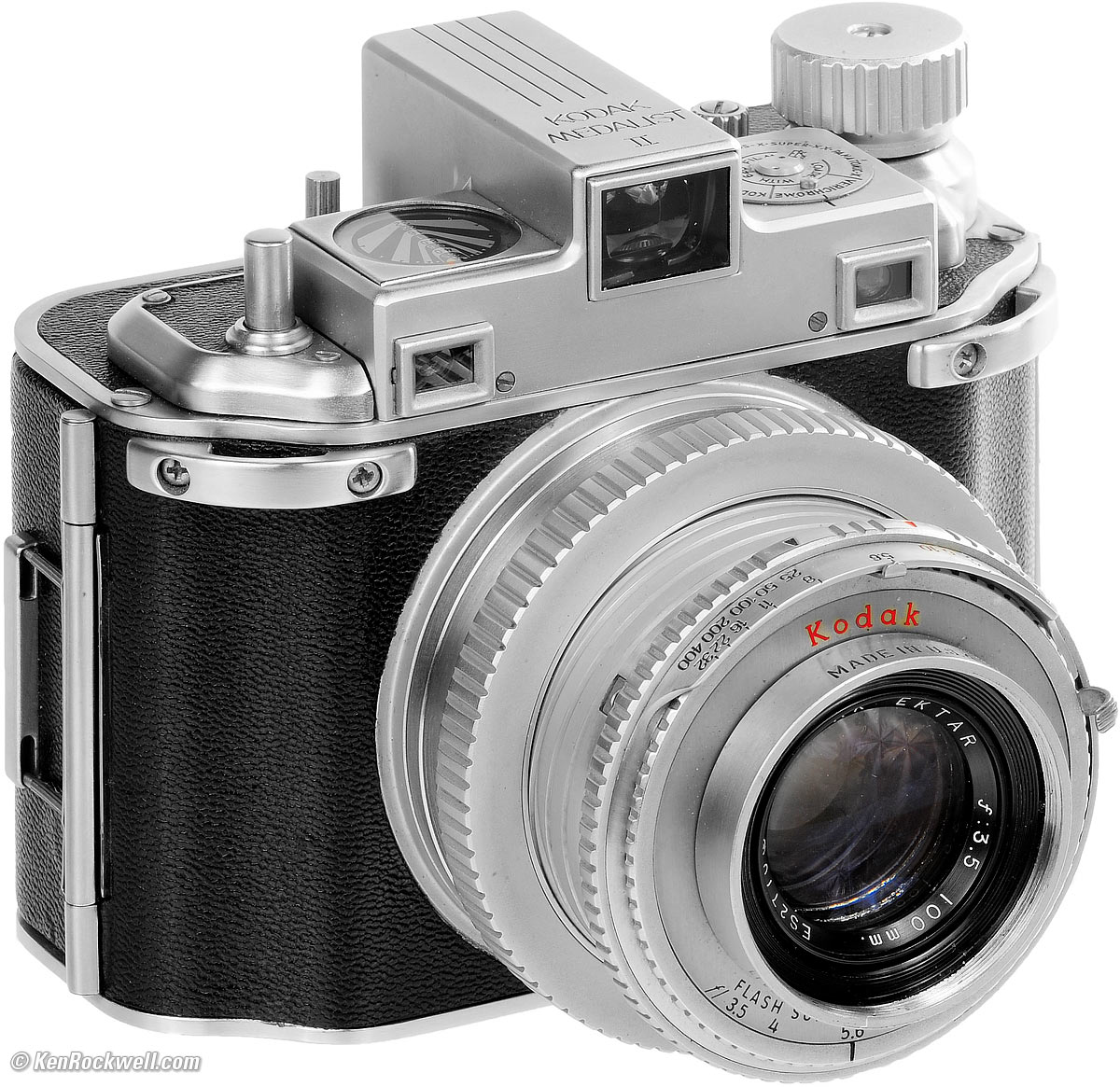
The Medalist II isn't actually a pre-war camera. Its older sibling, the original Medalist, launched in the early 1940s and became a fixture of WWII military kit — but the Medalist II is the post-war refinement, produced by Kodak from 1946 to 1953. It's a distinction collectors care about, because the two models aren't identical twins so much as siblings who grew up in different eras.
The original Medalist was designed by Walter Dorwin Teague and Joe Mihalyi, the design partnership behind most of Kodak's high-end cameras of the era, and it was built like it expected to go to war — because it did. Weighing slightly more than three pounds with a cast-metal, tank-like build, it became an attractive option for the US and British armed forces and saw extensive service in WWII. The Navy reportedly stripped the lenses off roughly 200 Medalists to repurpose them for stereoscopic aerial reconnaissance cameras — which tells you something about how highly Kodak's own optics division rated that glass. Even the finish was mission-driven: e.g. the focusing helical reflected the camera's military-minded engineering. Early Medalists soon adopted a black anodized aluminum helical, replacing the original bare aluminum. The anodized finish greatly improved wear resistance and reduced the aluminum-on-aluminum galling that can cause threaded parts to seize, while also providing much better protection against corrosion—an obvious advantage for equipment expected to endure harsh naval service. When the postwar Medalist II arrived, the helical retained its anodized finish but returned to its natural silver appearance. Kodak Medalist II sold for $312.50 when introduced, including a leather case. Adjusted for inflation, that equals approximately $4,600 in 2026, making it one of the most expensive cameras of its era.
The Kodak Medalist II is a robust medium-format rangefinder with a fixed lens, producing eight 6×9 cm negatives per roll. It was designed for 620 film, which is identical to 120 film except for its smaller spool. Today, most owners modify the camera to accept standard 120 film, while some enthusiasts either respool 120 film onto vintage 620 spools in the darkroom or purchase pre-respooled 620 film from specialty suppliers.
The lens is really the reason people still chase this camera down. Both Medalists carry a 100mm f/3.5 Ektar, five elements in three groups, built into a collapsible mount so most of it retreats into the body when not shooting. It's a near-silent leaf shutter physically integrated into the lens barrel, running from 1/400 down to a full second plus bulb, stopping all the way to f/32, and accepting Series VI filters. On the Medalist II specifically, Kodak added a new coating to the elements, an improvement collectors and shooters still notice in modern side-by-side comparisons against the coarser coating on the original Medalist I. On the 6x9cm negative this produces, 100mm actually renders close to the mathematically "correct" normal focal length for that format — closer, in fact, than 50mm is to 35mm film, since the diagonal math works out to almost exactly 43mm. People who've run real film through one describe it in almost reverent terms: sharp enough that photographers today still specifically seek out Kodak's own Ektar 100 film stock just to do the lens justice.
What makes the Medalist line more than a curiosity is the position it occupies in camera history. Some longtime collectors argue it represents the high point of American camera engineering — a deliberately different philosophy from the German rangefinders of the same period, less obsessed with miniaturization, built instead around ruggedness and optical brute force. Kodak tried to carry that torch forward with the Chevron in 1953, a similar body with a wider 78mm Ektar, but by the mid-1950s American buyers had lost their appetite for an expensive homegrown medium-format rangefinder, and the Chevron was discontinued by 1956, closing out the lineage for good. What's left behind has genuine dual appeal — camera collectors want it for the optics and industrial design, militaria collectors want it for its WWII service record — and that crossover demand is a big part of why clean examples don't sit on shelves for long. At $495, a Medalist II with its original 100mm Ektar isn't a novelty purchase; it's a working piece of a very short, very specific chapter in American manufacturing that Kodak never quite repeated.