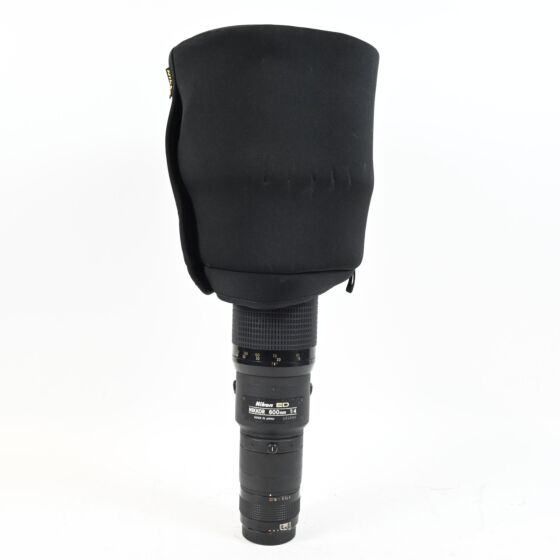
Pick this lens up and you'll understand the classifier's hesitation immediately — this is a serious piece of glass, the kind that makes a camera bag feel like carry-on luggage for industrial equipment. But the story behind it is more interesting than the intimidating size suggests. Nikon's love affair with extra-low dispersion glass in long lenses didn't start here. It traces back to a family of ED telephotos — a 300mm f/4.5, 600mm f/5.6, 800mm f/8, and 1200mm f/11 — that Nikon built for the 1976 Innsbruck and Montreal Olympics, engineered specifically to tame chromatic aberration for photographers chasing fast action from a distance. The 600mm f/4 ED-IF that eventually followed was a bolder move: a full stop faster than that original 600mm f/5.6, built around Nikon's newer Internal Focus system rather than the older, unwieldy focusing-unit designs that had made earlier long Nikkors so front-heavy.
Nikon brought this exact optical formula into the world in June 1977, launched alongside the brand's new AI metering system that let lenses communicate maximum aperture directly to the camera body. From the start it carried the features that defined it for the next decade: nine aperture blades, a manual-focus-only design (there was no other option for a lens this size at the time), a built-in telescopic hood, and drop-in 39mm rear filters instead of the comically large front filters a 600mm f/4 would otherwise demand. In 1986, Nikon updated it again as an AI-S lens, giving it a modified barrel profile and a fixed protective glass plate over the front element — small but telling refinements that suggest Nikon kept tuning this design rather than abandoning it. That AI-S version reportedly paired well with Nikon's TC-14B teleconverter, stretching it to an effective 840mm at f/5.6, though the TC-301 converter apparently degraded image quality enough that Nikon shooters didn't recommend it except in a pinch.
Worth clearing something up here, since the 'bellows' language in the listing note is a little misleading: true Bellows-Nikkor lenses were an entirely different animal — optics with no internal focusing mechanism of their own, designed to be racked back and forth on an accordion-style bellows attachment for macro work. This 600mm f/4 is the opposite philosophy: its whole reason for existing was Internal Focus, keeping the barrel length constant and the weight balanced while a preset focusing aid let shooters snap back to a known distance without hunting. If a specific example does show sluggish or uneven focus travel today, that's almost certainly age and grease, not some bellows-based design quirk.
What keeps collectors circling lenses like this one isn't nostalgia alone — it's that the AI-S coupling still meters correctly on modern Nikon F-mount bodies with an AI indexing tab, all the way through cameras like the D780, so it's not a shelf piece. It's a lens you can still mount and shoot, provided you've got a sturdy tripod or gimbal head and the patience for manual focus at 600mm. Nikon kept building on this same 600mm f/4 concept for decades afterward — motorizing it, lightening it, eventually adding autofocus and then Vibration Reduction — but this early manual-focus generation is where the formula was proven. At $1,220 (Glass Hound find) for a lens whose direct descendants have sold used for well over that in recent years, a clean, correctly functioning copy of this original design is a genuinely reasonable way into a real piece of Nikon's optical history.