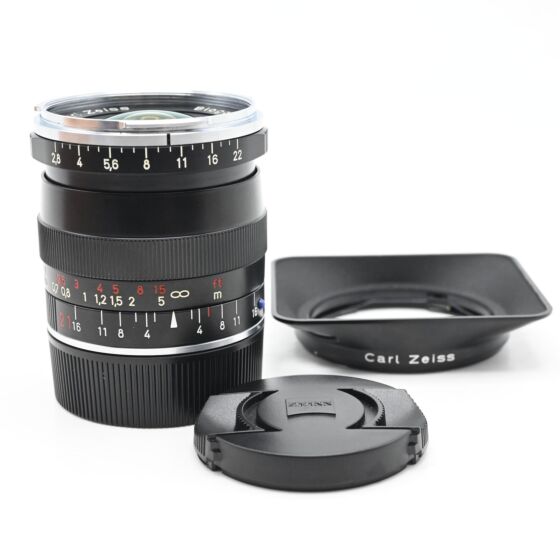
Here's the thing about the word "Biogon" on a lens barrel: it's one of the oldest trade names in optics, and it's earned every bit of its mystique honestly, even if the story is a little more tangled than the marketing copy lets on. The name goes back to 1934, when Ludwig Bertele — one of the great lens designers of the 20th century — cooked up the first Biogon (2.8/3.5 cm) while working for Zeiss, a design soon assigned to Zeiss Ikon Dresden and marketed with the Contax rangefinder system. The original Biogon was a modification of his earlier Sonnar design from 1929. In 1951, working for Zeiss in Oberkochen, Bertele revisited the formula (that new Biogon was Bartele's 1950 Aviogon, simplified) and pushed it out to a 90-degree angle of view, and by 1954 that recomputed design was in production as a 21mm f/4.5 for Contax rangefinders. The Biogon's symmetrical, deeply recessed-front-element layout became the go-to solution for distortion-free ultra-wides for decades — Hasselblad's Super Wide Camera (first introduced in 1954) used a Biogon derivative, and Biogon-derived lenses are widely reported to have flown with NASA's Hasselblads during the Gemini and Apollo programs, which is where a lot of the lens's mythology comes from, even though that's a related design on a completely different camera system, not the M-mount lens sitting in this listing.
The lens actually in question — the Biogon T* 21mm f/2.8 ZM — is a much more recent chapter. In 2004, Zeiss did something nobody quite expected: after decades out of the rangefinder camera business, it partnered with Cosina in Japan to launch the Zeiss Ikon ZM, a Leica M-mount film rangefinder, alongside a whole family of ZM-branded lenses. Seven lenses were announced at photokina that year, including this 21mm f/2.8, and they started shipping the following year, manufactured in Japan under Zeiss's own quality control (with the longest and shortest lenses in the lineup — and easily the priciest — built in Oberkochen instead). It's worth being upfront that this ZM 21/2.8 isn't literally Bertele's 1951 formula recycled — Zeiss has reused the Biogon name for several distinct optical designs over the years that don't share a common construction, so the lineage here is more about philosophy and branding than an unbroken optical bloodline. Still, the semi-symmetrical, low-distortion approach that made the name famous is very much present in how this lens behaves.
And it behaves well. Reviewers who've shot it side by side with Leica's own 21mm options have found its edge distortion no worse than the Leica 21mm Elmarit ASPH and notably better controlled than the Leica 21mm Summilux ASPH — genuinely elite company for a lens that's historically sold for less than either. It's sharp wide open, controls flare thanks to Zeiss's T* coating, and stays compact enough to disappear into a rangefinder kit, though — like basically every 21mm rangefinder lens ever made — you'll want the optional external viewfinder for accurate framing, since the M-mount's built-in frame lines don't go that wide. One reviewer clocked the new retail price at around $1,340 back in 2010, and the lens has held its value stubbornly ever since; it's still sold new today (August 2026, $1359, BHPhoto), which is unusual for glass this old, and used copies are generally reported to sell for somewhat less than new, though exact used pricing varies by condition and finish.
Which is what makes a sub-$900 copy found by Glass Hound worth pausing on. This isn't a lens that shows up on clearance because nobody wants it — it's one that photographers specifically seek out for architecture, interiors, and reportage work precisely because Zeiss never stopped making it and rangefinder shooters never stopped buying it. The Zeiss Ikon camera it was born alongside got discontinued back in December 2012, but the lens outlived it, quietly earning cult status among the small, stubborn population of people who still think a 21mm frame line and a rangefinder patch is the best way to see the world.