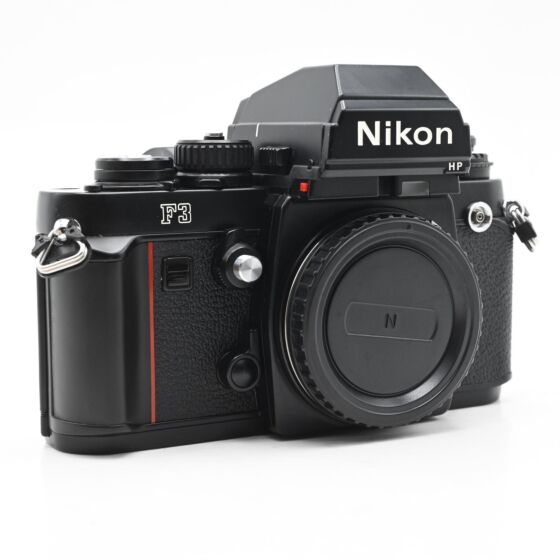
Talk to enough old-school shooters and the Nikon F3 comes up like an old war buddy. Nikon rolled it out in March 1980 as its flagship, and the body itself was a bit of a shock at the time: it was designed by Giorgetto Giugiaro, the Italian car designer better known for shaping Alfa Romeos and the VW Golf, and it introduced the little red stripe on the grip that's still a Nikon signature today. Under the skin it was just as radical—this was the first Nikon pro body built around electronic, aperture-priority exposure control, a real departure from the all-mechanical F and F2 that came before it.
The 'HP' in F3HP just stands for High-Eyepoint, and it's really a story about eyeglasses. The F3 originally shipped with the DE-2 prism finder, which was great optically but murder to use if you wore glasses—you couldn't see the whole frame without mashing the eyepiece into your face. Nikon's fix was the DE-3 finder, which traded a little magnification (0.75x versus the DE-2's 0.8x) for dramatically more eye relief, so eyeglass wearers could finally see the full frame comfortably. Any F3 wearing a DE-3 finder became known as an F3HP, and the design proved good enough that Nikon carried the same high-eyepoint philosophy forward into essentially every pro body after it, through the F4, F5, F6, and beyond. One thing worth flagging honestly: sources disagree on exactly when the DE-3 arrived—some say 1981, others 1982 or 1983—so treat any precise date for the finder itself as a bit fuzzy rather than gospel.
Where the F3 earns its legend, though, is off Earth. NASA modified the F3 for Space Shuttle astronauts, developing special non-migratory lubricants (since normal lubricant tends to drift and contaminate things in zero gravity) and a coreless motor that let the camera rip through roughly 140 rolls of film on one set of batteries—engineering work substantial enough that NASA itself later cited it as a spinoff technology. The agency actually declared the F3 an official NASA camera while it was still in development, building 'Small Camera' and 'Big Camera' variants that flew aboard shuttle missions starting around 1981.
Back on the ground, the F3 became the default tool for a serious slice of working photojournalists through the 1980s and 90s. Steve McCurry shot with one during his analog years, and it's been closely associated with names like war photographer Eddie Adams, wildlife photographer Jim Brandenburg, and fashion photographer Peter Lindbergh. It's worth being careful here—plenty of 'famous photographer used this camera' claims floating around forums and gear blogs are secondhand or unsourced, so it's safer to treat the well-documented names as the real anchor rather than every camera-forum anecdote.
What makes an F3HP like this one attractive to a collector today isn't scarcity—Nikon kept the F3 in production for roughly 21 years, so bodies aren't rare—it's the combination of a genuinely significant design pedigree, real professional battle-scars, and a finder upgrade that working photographers specifically asked for and Nikon delivered. At a fair market price with no discount angle, you're not buying a bargain; you're buying a clean example of a camera that quietly did as much to define 'professional 35mm SLR' as almost anything Nikon ever made.