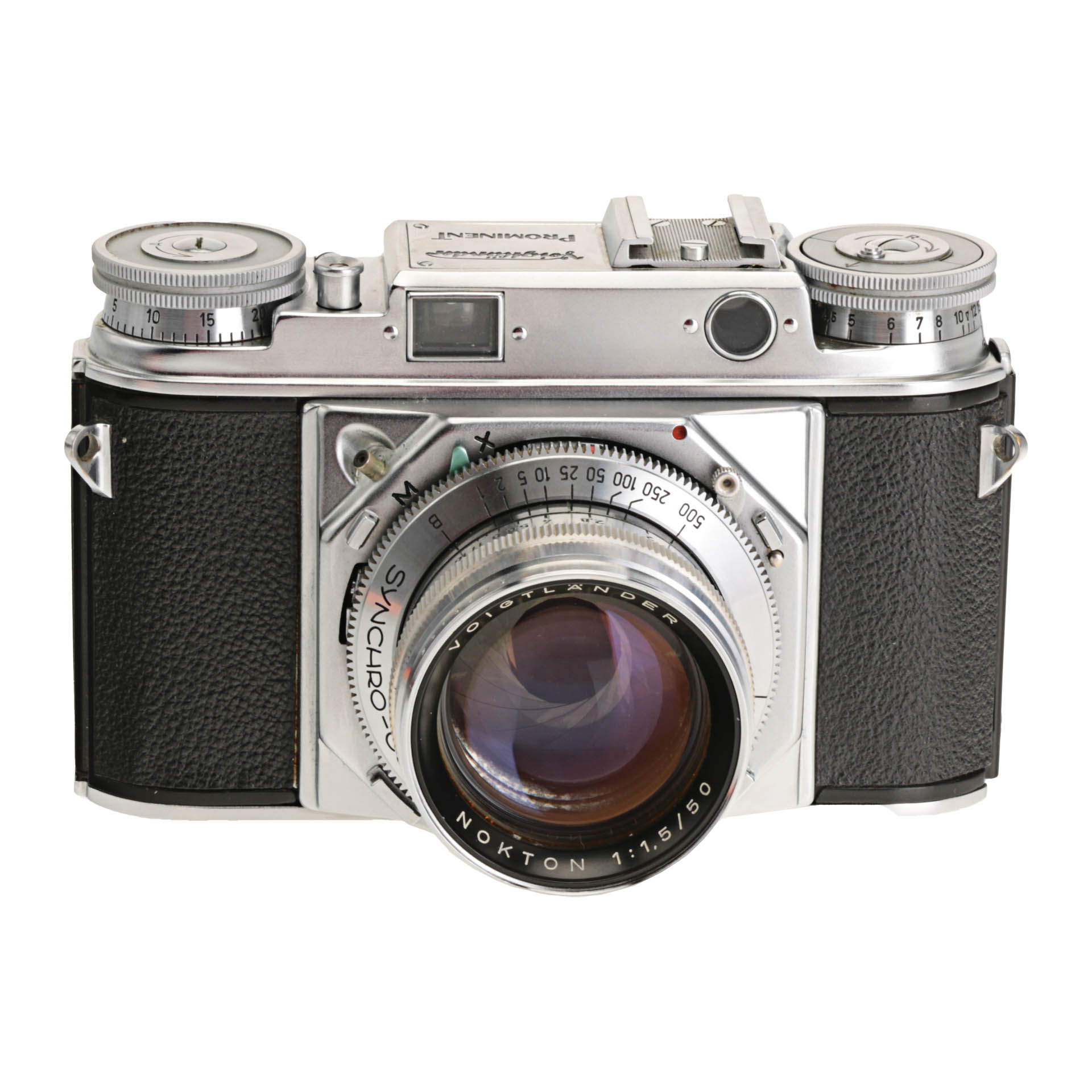
Let's start with the headline claim, because it's actually true and not just eBay hype: the Voigtländer Prominent was the first 35mm rangefinder camera with a leaf shutter and interchangeable lenses. Leica and Contax were running focal-plane shutters and swapping lenses just fine, but nobody had combined a coupled rangefinder with a behind-the-lens Compur shutter and a full interchangeable-lens system before Voigtländer pulled it off in Braunschweig. Camera-wiki and multiple camera historians credit it as the first of its type, predating that particular combination in anything from Leitz, Zeiss or Contax.
The dates get a little fuzzy depending on who you ask — some sources say 1950, and Mike Eckman's deep-dive on the camera argues the real release was 1952, with 1950 being a commonly repeated error. Either way, it launched as Voigtländer's flagship, aimed squarely at the professional market that Leica and Contax owned, and it came loaded with genuinely clever engineering: MX flash sync at every shutter speed, a self-timer, double-exposure prevention, and the ability to change film mid-roll (wow!). Collectors and reviewers alike describe it as a true 'system' camera in the Leica mold, with a full lineup of lenses from a 24mm ultra-wide (scarce monstrous f/5.8 Ultragon) to a 150mm tele. But it was also, by pretty universal agreement, a little eccentric to actually use — the focusing knob does a 270-degree left-handed turn in the spot where you'd expect a rewind knob, and one lens reviewer flatly calls the camera's ergonomics 'love it or hate it.' It never outsold Leica or Contax, and the improved Prominent II, introduced in 1958 with a much better viewfinder, only lasted two years before Voigtländer discontinued the line in 1960 — which is exactly why clean Prominent II bodies are genuinely scarce today.
The lens is really the star here, though. The 50mm f/1.5 Nokton was designed by Albrecht Wilhelm Tronnier, a variant of the classic double-Gauss formula with 7 elements in 5 groups, and it earned a reputation almost immediately as one of the best fast fifties of the era — a reputation that's held up remarkably well. Modern shooters who adapt it onto mirrorless bodies (a whole cottage industry of Prominent-to-Leica-M helicoid adapters exists specifically for this) consistently single it out for its swirly, painterly bokeh and vintage rendering rather than clinical sharpness; the camera's own in-house rival, the Ultron 50mm f/2, is generally regarded as the sharper, more 'correct' lens, while the Nokton is the one people chase for character. One quirk worth flagging for any new owner: like a lot of fast lenses from this era, the rear element used thorium glass and does register as mildly radioactive on a Geiger counter — cosmetically it can cause a yellowish tint over decades of storage that's reversible with UV or sunlight exposure, and it's a detail collectors of 1950s optics tend to know and shrug off rather than worry about.
What makes a find like this interesting isn't a famous-photographer story — there isn't a well-documented one attached to this particular camera. What makes it interesting is that the Prominent occupies a strange, appealing niche: mechanically gorgeous, historically first-of-its-kind, commercially a bit of a flop, and mounting a lens that's become genuinely cult-status among people who adapt vintage glass to digital. It's the kind of camera that reviewers today still call 'a bit of an enigma' — not as chased as a Leica M3, but absolutely worth having, especially at a price that undercuts what a clean Nokton alone often commands on its own.