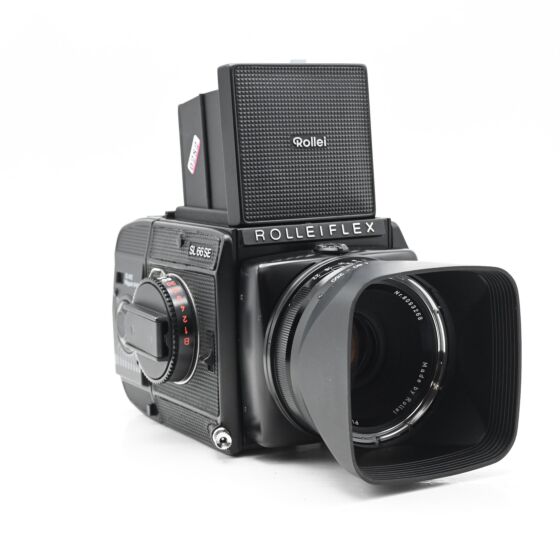
In 1957, Reinhold Heidecke, the man who had built Rollei's name on twin-lens reflex cameras, shook hands with Victor Hasselblad and agreed to a deal: Rollei would stay out of the SLR market, and Hasselblad would stay out of TLRs. It was the kind of gentlemen's agreement that sounds sensible in a boardroom and absurd in hindsight, because the deal was already dead when it was signed.
Rollei had quietly started developing its own medium-format SLR two years earlier, in 1955. The 1957 handshake didn't stop that work outright, but it didn't help it either. Then Heidecke died in 1960, and the project he'd agreed to shelve sat half-finished until new management picked it back up and pushed it through in the mid-1960s, in time to debut at the 1966 Photokina in Cologne. The promise had outlived the man who made it by six years.
What's interesting is what Rollei did with the freedom once they'd taken it. They didn't build a Hasselblad with a different badge. Hasselblad had already dropped its focal-plane shutter for a leaf shutter in 1959; Rollei kept the focal-plane design and hung a bellows behind the lens mount instead of a helicoid. That single choice let the SL66 do things no other 6×6 SLR could: reverse-mount its own lenses without adapters for macro work, and tilt the front standard up to eight degrees to exploit the Scheimpflug principle — a view-camera trick, on a roll-film SLR, decades before anyone thought to sell that as a lens for 35mm bodies.
None of it was free. The SL66 came in at just over two kilos, nearly half a kilo heavier than the Hasselblad it was aimed at, and it launched at $1,300 against Hasselblad's $750. A camera built to prove Rollei could still compete opened by being the harder, heavier, pricier sell.
The manual didn't pretend otherwise. It opens with a line that reads less like marketing copy and more like a warning: "A camera for experts…"
The kit on offer now is the SL66SE, the line's last and most electronic version, released in 1986 with a built-in meter that could switch between spot and center-weighted readings using up to five photodiodes — a concession to convenience grafted onto a body that still did its focusing with cloth and a rail. Rollei made roughly 3,500 of them, and kept the line running until 1992, a decade after the company's own bankruptcy and three decades after the promise it was built to break.
It's a strange kind of monument: a camera that exists because a handshake failed to hold, built by engineers who used that failure not to catch up to a rival, but to make something the rival's own architecture couldn't do.