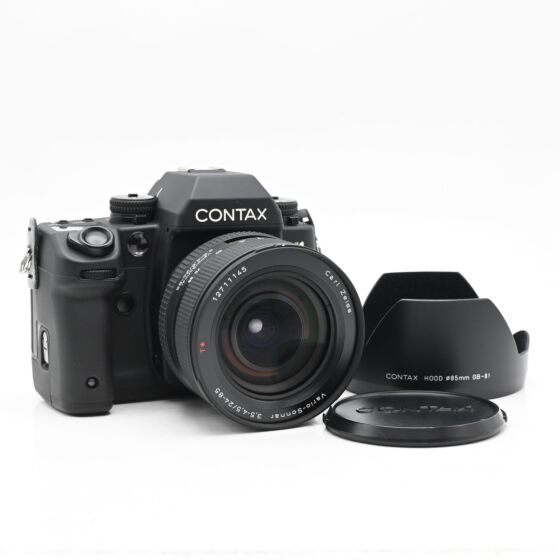
Here's the short version of a genuinely strange story: in 2000, Kyocera and Carl Zeiss decided to bet everything on a brand-new autofocus camera system, right as the entire film industry was quietly walking out the door. The Contax N1 was the result — a 35mm SLR that was, by most accounts, the last film SLR ever to wear the Contax name and one of the final Contax cameras of any kind. It arrived aimed squarely at professionals, built to trade blows with the Nikon F5/F6 and Canon EOS-1V, and reviewers have praised its build quality and handling, including one contemporary account calling the system 'a beautifully made combination of ultrasophisticated 35mm camera engineering.'
What makes the N1 a genuine oddity in camera history is that Contax had to burn its own bridges to build it. Every prior Contax and Yashica SLR since 1975 used the manual-focus C/Y mount — including Zeiss's beloved Planar and Sonnar lenses. For the N1, Kyocera threw all of that away and engineered an entirely new autofocus N-bayonet mount from scratch, reportedly over the objections of Zeiss's own lens designers, who were resistant to autofocus optics in the first place. Canon and Minolta had already made similar mount-breaking leaps to autofocus back in the 1980s — but Contax was doing it roughly fifteen years later, long after the rest of the professional market had settled on its systems.
The gamble didn't pay off. The N1 launched roughly fifteen years after Canon's EF mount, and the market had already made up its mind — sales were poor, and the camera was largely gone from shelves not long after release. Kyocera doubled down anyway, releasing the Contax N Digital in 2002, which was the world's first full-frame digital SLR, built on the N1's platform and sharing its basic functions and unique features — a legitimately significant technical milestone that got buried by a camera few people bought. By April 2005, Kyocera had shut down camera production entirely and walked away from its Zeiss partnership for good, closing the book on the Contax name.
Which brings us to why a kit like this matters today. The 24-85mm f/3.5-4.5 Vario-Sonnar T* that usually accompanies these bodies is a 14-element, 12-group zoom with Zeiss's signature T* coating, and it reportedly carried a launch guide price of around £1,200 on its own — a serious optic bolted to a camera most people have never heard of. The D-10 data back is its own small piece of clever engineering: rather than burning exposure data into the visible frame like most cameras of its era, it stores the information and only imprints it on the first couple of frames of the roll after you rewind, so your pictures stay clean. Because so few N-mount lenses were ever produced and the system never built a following, complete, working outfits like this one are legitimately uncommon. A full body-lens-data back kit for $665 isn't hype pricing on a famous name — it's an oddball, orphaned, over-engineered system finally trading at what its rarity actually deserves.