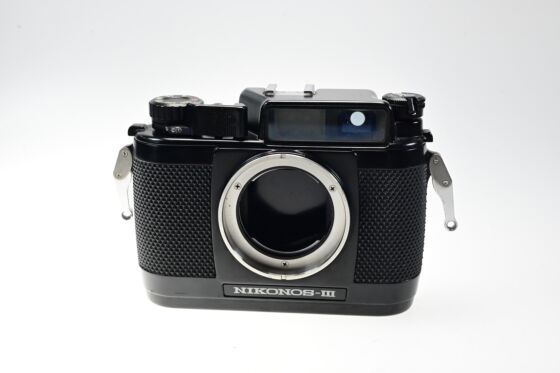
Here's the thing that makes the Nikonos III weird, even by cult-camera standards: it wasn't designed as a camera that could survive water. It was designed from a blank sheet of paper to live in water, with land photography as the afterthought. That distinction traces back to Jacques Cousteau, who wanted something better than jamming an ordinary camera into a bulky housing. Working with Belgian engineer Jean de Wouters, Cousteau's team at the French diving-equipment company La Spirotechnique produced the Calypso, a self-contained 35mm camera that needed no housing at all and could go straight from a boat deck into the sea. Nikon licensed the design, refined it, and released it in 1963 as the Nikonos, kicking off one of the strangest and longest-running side projects in camera history.
The III arrived in 1975 as the third and, as it turned out, final purely mechanical version before Nikon moved to electronics with the IV-A in 1980. It fixed the two things divers actually complained about: film advance and viewfinding. Earlier Nikonos bodies lacked a proper sprocket for film transport, so frame spacing could drift; the III added a sprocketed shaft and a second slot on the take-up spool to make loading easier. It also swapped in a brighter, window-type viewfinder with projected frame lines for both the standard 35mm lens and the optional 80mm, and moved the frame counter to a more sensible spot on top of the body. None of this involved a single battery or circuit board — everything runs on springs, gears, and O-rings, which is exactly why divers and collectors still trust it decades later.
The optics have their own quirk worth knowing: the standard 35mm f/2.5 Nikkor was engineered around water's higher refractive index, so when submerged it behaves like roughly a 47mm lens rather than a true 35mm. Its front element is a flat, protective glass, which is precisely why it can also be used comfortably above water — something several of the more specialized underwater-only Nikonos lenses can't claim. That dual-use flexibility was intentional; Nikon wanted a camera that photographers would actually carry on land, not just strap on for a dive.
And carry it they did, in some unexpected places. Because the Nikonos line was sealed against rain, mud, and humidity as a side effect of being sealed against the ocean, it picked up a reputation among photographers covering the Vietnam War, who valued a camera, nicknamed “The Workhorse of the War”, that could shrug off monsoon downpours and rice-paddy crossings the way a delicate SLR couldn't. That connection shows up repeatedly in camera retrospectives and forum histories, though it's worth saying plainly: this is a reputation built on documented battlefield conditions and period accounts, not a single famous name attached to a single famous photo — so treat it as a well-earned nickname rather than a celebrity endorsement.
As for the deal itself: a clean Nikonos III with its 35mm f/2.5 lens typically changes hands in the $165–250 range on the used market these days, with the lens itself considered the most desirable part of the package. A body alone for $45.36 (recent Glass Hound find) sits well under that, which is presumably why it got flagged — this is a legitimately collectible, still-usable (maybe after some CLA) piece of underwater photography history at a price that would normally only cover the O-ring kit.