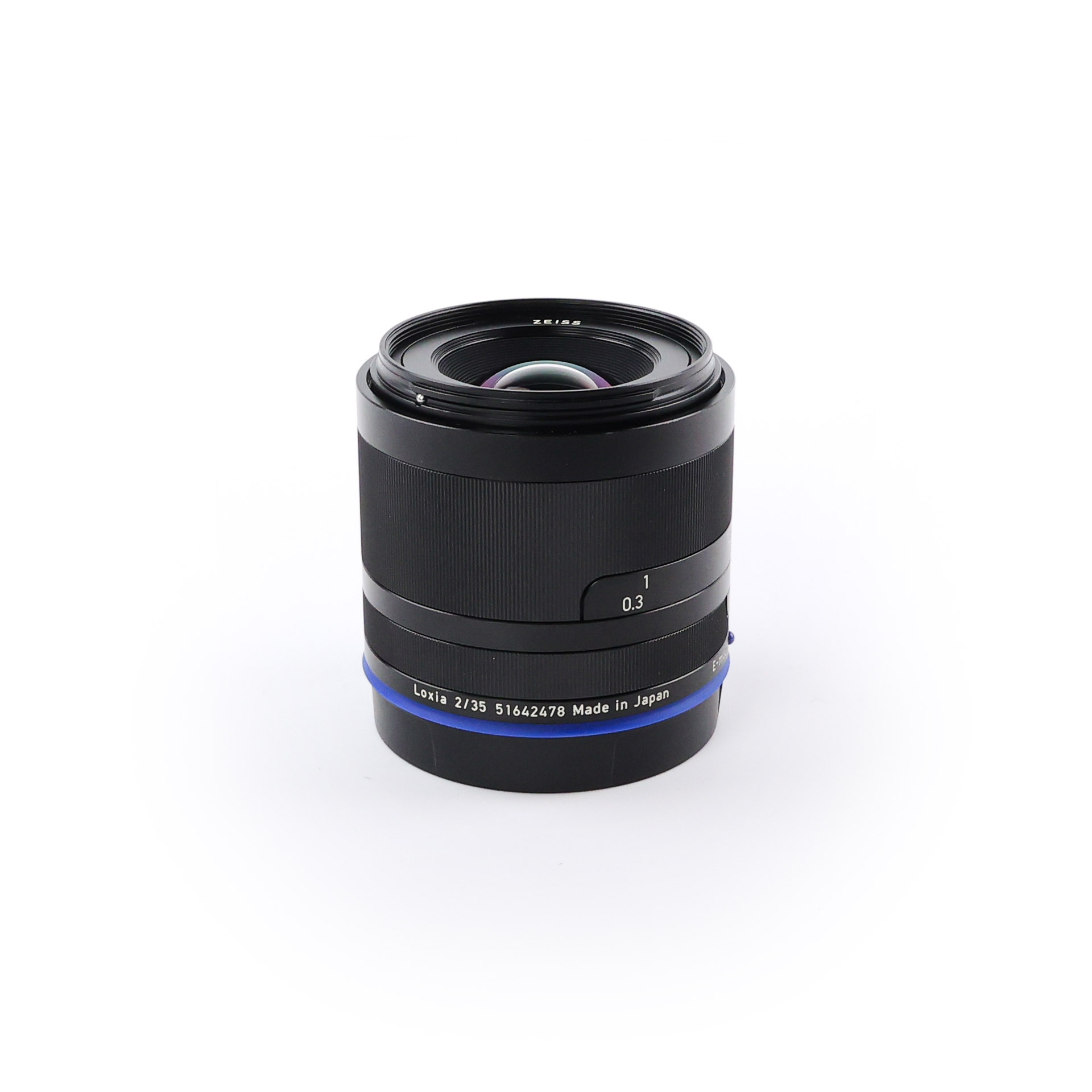
There are lenses that you pick up, mount, and start shooting with. Then there are lenses that make you slow down before you even put them on the camera.
The Zeiss Loxia 35mm f/2 is firmly in the second category.
It is a compact, metal-bodied manual-focus prime for Sony E-mount cameras, built around a 35mm Biogon optical design. The focus ring turns with the kind of deliberate resistance that has become increasingly unusual in modern lenses, and the aperture ring is mechanical. There is an electronic interface, so the lens can still communicate shooting data to the camera, but the actual business of focusing and setting the aperture stays in your hands.
And right now, one has surfaced at National Camera Exchange for $329.99.
That number deserves some attention. Zeiss announced the Loxia 35mm f/2 in September 2014, with a U.S. recommended retail price of $1,299, and the lens was scheduled to reach the market toward the end of that year.
That makes $329.99 roughly a quarter of its original U.S. asking price.
But the interesting part of the Loxia isn't really the discount. It's what's inside the barrel.
The lens uses a Biogon design with nine elements in six groups, the same basic element/group count found in Zeiss's Biogon T* 35mm f/2 ZM for Leica M-mount cameras.
Biogon is one of those optical names that carries considerably more history than most photographers realize. Ludwig Bertele developed the original Biogon design in the 1930s from his earlier Sonnar work. The first version was associated with the Zeiss Ikon Contax rangefinder system, establishing a lineage that eventually led through several generations of compact, highly corrected wide-angle lenses.
The Loxia is not simply an old rangefinder lens with a Sony mount bolted onto it, though. That distinction matters. Zeiss specifically optimized the Loxia optical design for Sony's full-frame digital cameras, taking the characteristics of the digital sensor assembly into account. The result retains the Biogon concept while addressing the particular requirements of a modern mirrorless camera.
On paper, it is a fairly restrained lens: 35mm, f/2, manual focus, 0.30-meter minimum focusing distance, and a 180-degree focus throw. It weighs 340 grams and uses a 52mm filter thread. In practice, that restraint is the point.
The Loxia 35mm was designed at a time when Sony's full-frame mirrorless system was still young, and Zeiss took a very different approach from the autofocus-heavy lenses that would eventually dominate the E-mount. It is a lens that asks the photographer to participate.
And that makes the $329.99 example at National Camera Exchange interesting.
For someone looking for the latest autofocus technology, there are obviously newer choices. But if what you want is a small, exceptionally well-built 35mm with a genuine optical pedigree and a tactile shooting experience, this is the sort of used-market price that deserves a second look.
The Loxia was expensive when it arrived. At $329.99, it is something else entirely.