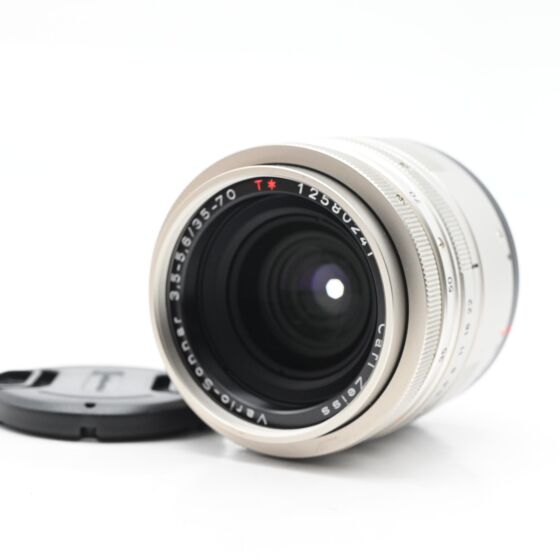
If you know the Contax G system at all, you know it as one of photography's great 'what if' stories. Kyocera unveiled the titanium-clad Contax G1 at Photokina in 1994, and it was a genuine oddity: a full-frame 35mm rangefinder with autofocus, built around an entirely new electronic lens mount instead of the Leica M or screw mounts everyone expected. It won Japan's Camera Grand Prix award (the honor for 1995, awarded the year after its launch), and two years later the improved G2 arrived with a wider rangefinder base and faster shutter speeds. Depending on who you ask, the G2 was either a brilliant reinvention of the rangefinder or a doomed detour — but either way, it was the first all-new interchangeable-lens rangefinder system since the Leica M itself debuted in 1954.
The Zeiss glass built for that mount is the real reason people still chase G-series gear, and the 35-70mm f3.5-5.6 Vario-Sonnar T* was the last piece of the puzzle. The G-mount started with just three lenses — the 45mm f2 Planar, 28mm f2.8 Biogon, and 90mm f2.8 Sonnar — and grew over the following years to include the 21mm Biogon, 35mm Planar, and finally this zoom. Zeiss's own marketing at launch made a genuinely rare claim: coupled directly to the G2's auto-adjusting viewfinder so you could watch the frame lines shift as you zoomed, it was pitched as the only true zoom lens ever built for an interchangeable-lens rangefinder camera — a mechanical trick nobody else in that category had pulled off before or, really, since.
That's not just marketing spin. Rangefinder zooms are a genuinely hard engineering problem because the viewfinder framing has to track focal length without an SLR's through-the-lens view to bail you out. Zeiss built the 35-70 as a 13-element, 8-group design that stays a modest 72 x 63mm, with distortion correction optimized down around 0.5% at the wide end — a detail Zeiss made a point of because 35mm is exactly where distortion is hardest to hide on architecture and travel shots. It's also a lens tied to a specific body: it only works properly on the G2, since the original G1 wasn't wired for it (a handful of G1s got a firmware upgrade — look for a marked sticker in the film chamber if you're hunting one down).
Here's the twist that makes this particular lens a collector's curiosity rather than just another kit zoom: it arrived right at the end. Wikipedia and lens databases place its announcement in late 1999, making it the final lens added to a system that Kyocera would kill entirely within a few years — the company announced in April 2005 that it was ceasing all Contax manufacturing, and the whole G-mount, cameras and glass alike, simply stopped. That combination — last lens in, first brand out — is a big part of why G-mount glass in general trades thin. You'll see this exact zoom bounce between roughly $390 on the low end and well over $1,000 for a boxed, mint copy, with black-finish examples generally considered the scarcer variant next to titanium. A chrome copy priced in the high $300s isn't a steal exactly, but for a lens with this specific a footnote in rangefinder history — an engineering first that outlived its own camera system by only a few years — it's a fair price of admission into a very small club.