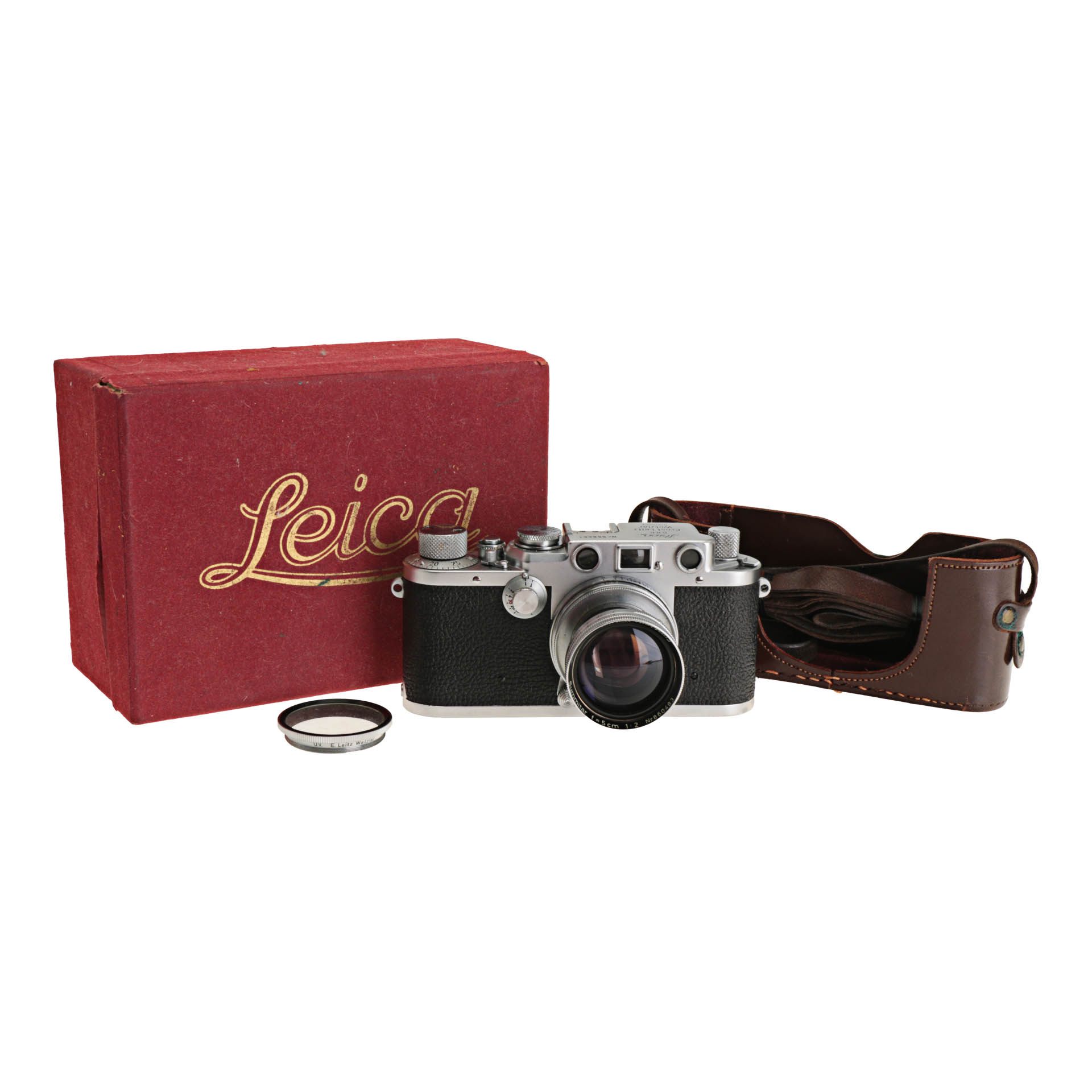
Here's the fun paradox of the Leica IIIf: by the time it hit shelves in time for Christmas 1950, it was already something of a dinosaur. Leica's own engineers were deep into designing the bayonet-mount M3, which would land in 1954 with a giant, unified viewfinder and quick lens changes. And yet the IIIf — the screw-mount Leica with the classic 1930s-style separate rangefinder and viewfinder windows — kept selling for years afterward, staying in production until 1956 or 1957 depending on which reference you check. Why? Because it was cheaper than the M3, and it was fully compatible with the decades of accumulated M39 screw-mount glass that photographers already owned. Sometimes the "obsolete" camera is the one people actually keep buying.
What made the IIIf a genuine step forward, rather than just a nostalgia object, was flash. Earlier screw-mount Leicas needed a bolted-on adapter to sync with flashbulbs — clunky and fiddly at a moment when photojournalism was leaning hard into available light plus fill flash. The IIIf built synchronization directly into the body, a small thing that mattered enormously to working shooters. It also carries a quirky little feature the M3 would drop and that still doesn't exist on modern digital M cameras: a diopter adjustment on the rangefinder itself, controlled by a lever coaxial with the rewind knob. The flip side is that the IIIf's finder lacks automatic parallax correction for close subjects, so shooting inside about 10 meters takes a bit of intuition rather than a readout.
The Summitar riding on top is arguably the more interesting story for glass nerds. Designed by Max Berek — the same optical designer behind Leica's earliest lenses — and produced roughly from 1939 to the mid-1950s, the Summitar was Leica's answer to making a faster, cleaner-performing normal lens than the soft, glow-prone Summar it replaced. It's a 7-element, 4-group collapsible design, and depending on when a given copy rolled off the line, you'll find real variation: early lenses are uncoated with a fussy 10-blade aperture, later ones single-coated with a simpler 6-blade design (with some overlap between variations so you may come across a coated 10-blade version sometimes - most sought after). None of them click when you turn the aperture ring, and the stops themselves are delightfully odd by modern standards — f/2, 2.2, 3.2, 4.5, 6.3, 9, 12.5 — a holdover from an era before Leica standardized on today's full-stop sequence. One practical warning collectors pass around: the front element on these is made from a notably soft glass, easy to scratch even with an overenthusiastic lens cloth, so condition really matters on a Summitar in a way it doesn't on later coated lenses.
Optically, nobody pretends the Summitar is a clinical performer — it's soft in the corners, prone to flare, and produces the kind of swirly, glowing rendering wide open that modern lens designers spend careers trying to engineer back in on purpose. That's precisely why it has a cult following rather than a footnote in Leica's catalog: shooters chasing a specific, dreamy look reach for a Summitar the way others reach for a Helios or an old Nikkor. There's also an anecdotal thread worth flagging rather than stating as settled: some gear-history round-ups describe Henri Cartier-Bresson using a Leica IIIf in the 1950s paired with either a 50mm f/1.5 Summarit or a 50mm f/2 Summitar. It's a fun detail if true, but it comes from general-interest "photographer's gear" listicles rather than a documented, primary-source account of his kit on specific assignments — so treat it as folklore rather than confirmed history.
Collector interest in the IIIf/Summitar combo today comes down to that mix of accessibility and authenticity: it's mechanically simple, fully repairable by the handful of specialists who still work on Barnack-era Leicas, cheaper to buy into than its IIIg successor (which routinely runs two to three times the price for a similar-condition example), and it still takes the same 35mm film everyone else's camera does. For someone who wants a genuinely usable slice of Leica's transitional post-war years — not a shelf queen, a shooter — this is close to the sweet spot.