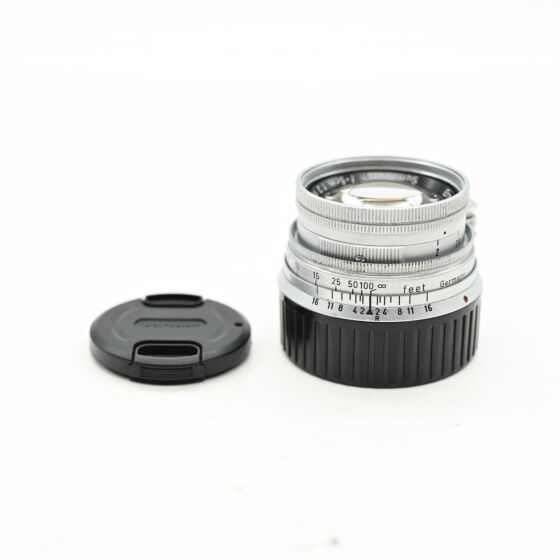
Here's the thing about the collapsible Summicron: it wasn't born out of confidence. It was born out of panic. In the early 1950s, Leitz watched a wave of Korean War combat photographers — famously led by David Douglas Duncan — start mounting screwmount lenses from a scrappy Japanese outfit called Nippon Kogaku onto their Leica bodies, because those Nikkor lenses were simply sharper. Leitz's answer, launched in 1953, was the 7-element Summicron 50mm f/2, a lens that replaced the older Summitar and used then-cutting-edge high-refractive-index lanthanum crown glass — glass so difficult to work with that it made the lens genuinely hard to manufacture. It worked, at least by most accounts: the lens quickly built a reputation as one of the sharpest 50mm lenses of its day, though a specific 'sharpest lens ever tested' quote sometimes attributed to Modern Photography magazine couldn't be pinned to a verifiable source and should be treated as unconfirmed. By 1954 it had become a standard 50mm companion for Leica's brand-new M3, the camera that basically invented the modern rangefinder experience.
The collapsible part isn't just a cute party trick, either. Twist, push, and the whole barrel retreats into the camera body, shrinking a fast f/2 lens down to something that disappears into a coat pocket — a real design compromise Leitz eventually abandoned in 1956 in favor of a sturdier rigid barrel, likely for manufacturing-cost reasons, though the collapsible version stayed in production alongside it for a few more years before fading out by 1960.
Now, the detail that gets whispered about in collector forums: the very earliest examples, made in the 1951-52 window before Leitz's own lanthanum glass supply came online in sufficient quantity, used thorium-doped glass sourced from a British glassmaker as a stopgap. Thorium is mildly radioactive, and over decades it causes the glass to yellow — which sounds alarming until you learn that a few days in direct sunlight bleaches most of it back out, a trick generations of Leica collectors have quietly passed down. It's a genuinely strange footnote: one of the most refined lenses of its era was, for a brief production run, also a faintly hot one.
What collectors actually care about today is scarcity of condition, not scarcity of units — these lenses used relatively soft glass and coatings by later standards, so clean, unscratched front elements are getting genuinely hard to find, and prices track that condition gap closely. A $599 example, assuming the glass checks out, is landing meaningfully under where clean collapsible Summicrons have been trading, which is exactly the kind of gap a want-list hound should notice before someone else does.