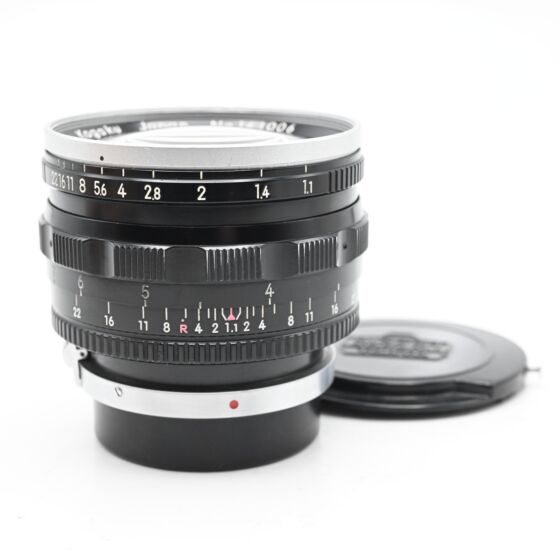
Grab a coffee, because this one has a real arms race behind it. In the early 1950s, Japan's optics makers were in a genuine speed war — not megapixels, just raw aperture. Nippon Kogaku (Nikon's parent) fired the first shot with a 50mm f/1.4 in December 1950, only to get leapfrogged in 1953 by a scrappy outfit called Teikoku Optical Industries (soon renamed Zunow), whose 5cm f/1.1 became the fastest lens ever sold for a 35mm camera. Nikon's answer, the Nikkor-N 5cm f/1.1, didn't arrive until February 1956 — and Nikon's own corporate history calls it plainly: it was just the second lens in history faster than f/1.2, the first being the ZUNOW 5cm f/1.1, released in 1953 by Teikoku Optical Industries.
The design work behind it is the kind of thing that makes collectors go weak in the knees. According to Nikon's own retrospective, engineer Murakami filed a patent application for the NIKKOR-N 5cm f/1.1 in 1957 and received a U.S. Patent the following year, after devoting two years of painstaking design work and prototyping to develop the lens. Remember, this was all done without computers — designers back then used only an abacus and a sheet of logarithms to conduct ray tracing calculations. Optically, Nikon didn't just copy Zunow's Sonnar-derived approach; the Nikkor used a fresh Gaussian layout, and a key innovation was the use of a newly developed type of optical glass made with the rare-earth element lanthanum in three convex lenses, which provided significant improvements in spherical aberration, curvature of field, sharpness, and image flatness.
Here's the part most people don't know: this lens actually exists in two structurally different versions, and the difference is a genuine engineering drama. The first Nikkor 5cm f/1.1s used an internal bayonet mount that relied on the camera body's own focusing helical — but the lens was so front-heavy that its weight could distort the camera mount and throw off rangefinder accuracy. Nikon's fix, released in June 1959, was the external-mount version — the type in the listing that just appeared— which was released with a redesigned barrel with an external mount, such as those found on the wide-angle and telephoto Nikkor lenses, giving the lens its own dedicated focusing helicoid instead of leaning on the camera's. As one collector site puts it, embracing that external bayonet meant crafting an individual focusing helicoid for every unit, and by incorporating the external bayonet, Nikon achieved superior focusing precision, particularly evident when handling weightier lenses like the F1.1 Nikkor. Crucially, the optics themselves didn't change — the optical formula is identical to the internal mount version, and both lenses used the same 62mm accessories, only the rear cap differed. Production was tiny either way: factory records state that 1,046 internal mount lenses were made (835 in Nikon bayonet mount and 211 in Leica screw mount) and 1,547 of the external mount version. And notably, cameraquest's own lens guide observes that the external version is more popular with collectors, and commands a higher price than the internal version — which is exactly what's sitting in this listing Glass Hound just found.
What cements the lens's legend, though, is what came after. Nikon repairman-historian Richard Haw notes plainly that it was Nikon's fastest lens, only to be replaced by the recent Nikkor Z 58mm f/0.95 S Noct after more than a half-a-century's time, and that it's considered to be a breakthrough for the company in terms of lens design and mechanical engineering. Nikon's own historian goes further, tracing a direct design lineage forward: the genesis of the AI Noct-Nikkor 58mm f/1.2 lens (1977) can be traced to the NIKKOR-N 5cm f/1.1, which is more than two decades its senior. That's a fifty-plus-year thread connecting a hand-calculated 1956 abacus lens to one of Nikon's most mythologized modern designs. Combine that pedigree with production numbers in the low thousands split across two mount types, and it's no surprise a lens database dedicated to cataloguing vintage glass flatly calls it one of the most impressive looking lenses made by Nikon and certainly one of the most sought-after by collectors. At $2,599 currently listed, you're not just buying a fast normal lens — you're buying a physical artifact from the exact moment Japanese optics stopped playing catch-up with Germany and started setting the pace.