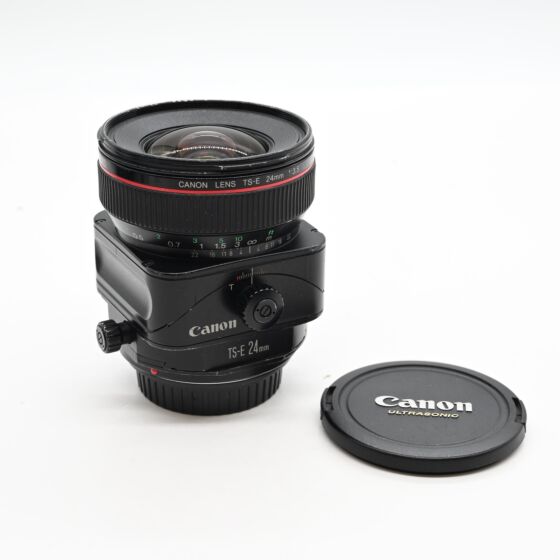
Every so often a lens crosses the used market that isn't really competing on sharpness charts or bokeh — it's competing on what it lets you do that nothing else can. The Canon TS-E 24mm f/3.5L is one of those. It's not fast, it's not autofocus, and at $329.89 it's currently going for a fraction of what it once demanded. But what it offers is something view-camera shooters have known for a century and 35mm photographers had to wait decades to get: full control over the plane of focus and the geometry of a scene, built right into an EOS-mount lens.
The lens dates back to 1991, when Canon introduced it alongside two siblings, a 45mm and a 90mm, as the original TS-E trio. Of those three, the 24mm was the only one to carry the L-series badge, Canon's mark of professional-grade optics. What made the whole line remarkable wasn't the focal lengths — it was the mechanics. A TS-E lens can tilt, shift, and rotate, letting the optical axis move independently of the sensor plane, which is exactly how a large-format view camera's bellows works. Tilt the lens and the plane of sharp focus swings to follow it, so a photographer can keep a road running to the horizon crisply in focus at a wide aperture, or conversely carve out a razor-thin sliver of sharpness for a dreamlike effect. Shift it, and converging verticals on a building straighten out without ever touching a computer. It's genuinely clever old-school optical engineering wearing an EOS mount.
The original version has a couple of charmingly analog quirks that give away its age. To change the relationship between the tilt and shift axes, you actually had to remove screws from the lens body — there was no smooth, click-stop rotation like later designs offered. And despite being a fully manual-focus optic with no autofocus motor at all, Canon engineered it with an electronic diaphragm (EMD) so it could still support auto-exposure metering, a neat bit of problem-solving for a lens that otherwise behaves like it escaped from a previous era of photography.
Canon eventually retired the design in 2009, replacing it with the TS-E 24mm f/3.5L II, which added independent rotation of tilt and shift without any screwdriver required, upgraded the optical formula from 11 elements in 9 groups to a more complex 16 elements in 11 groups, and bumped the movement range slightly. But the original never really disappeared from serious kits. Architecture and landscape photographers who came up on it still speak fondly of it, and reviewers who've shot both versions for decades still describe the Mark I as a perfectly good entry point into tilt-shift work if you can find a clean copy.
That's the real story behind why this particular listing is worth a second look. This isn't a gimmick lens or a relic gathering dust — it's the piece of glass that brought large-format perspective control into the 35mm and digital SLR world, manual focus dial and all, and it's still doing real work in the hands of photographers who care more about geometry than convenience.