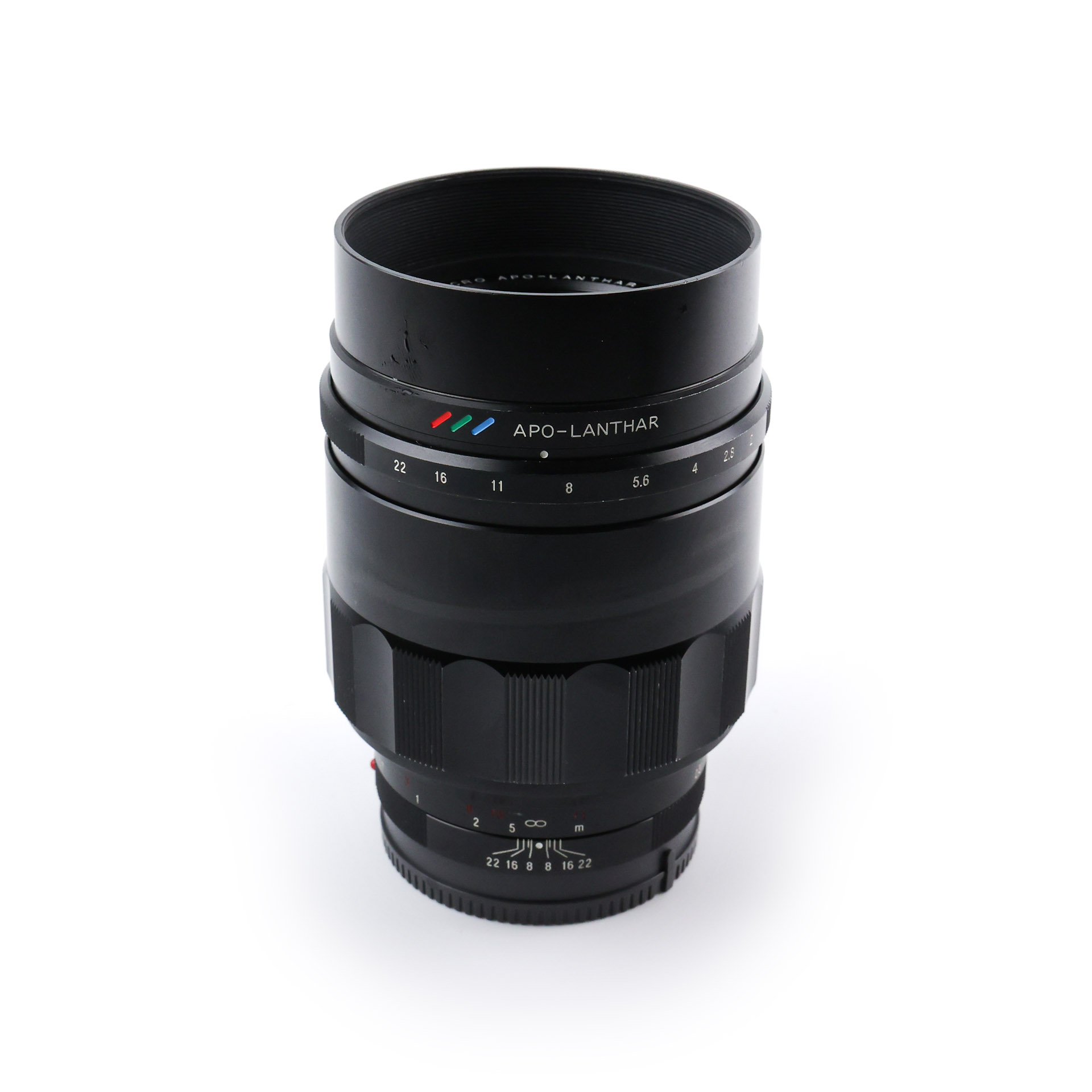
By the early 1950s, Albrecht Wilhelm Tronnier had already shown what he could do to a soft lens. He'd tightened up the Color-Skopar until it behaved at full aperture, the way a modern lens is supposed to. He wanted to do the same thing to the Heliar — Voigtländer's five-element design since 1900, prized for decades precisely because it didn't fully correct itself wide open.
He wasn't allowed to. According to Voigtländer's own documented history, Tronnier wanted to improve the Heliar's performance at full aperture the same way he had with the Skopar, but was stopped by Voigtländer director Adolf Oehme, who insisted on keeping the commercially valuable soft rendering at wide apertures — a look that was really just uncorrected coma and astigmatism. The improved design he built anyway wasn't allowed to carry the Heliar name. Multiple German references on the lens agree on why: for marketing reasons, it did not appear under the Heliar name, because the company didn't want to put the Heliar's reputation for that soft, glowing rendering at risk.
So the better lens became a different product. It emerged in 1952 as the Apo-Lanthar, using lanthanum glass with an unusually high refractive index and low dispersion, and it's generally credited as the first lens design corrected apochromatically — across all three primary colors rather than the usual two. A separate line of Apo-Lanthar optics followed for Voigtländer's medium and large format cameras from 1954 into the early 1970s, spanning four focal lengths from 105mm to 300mm, each one patented by Tronnier himself.
It sold in small numbers the entire time. Despite roughly two decades of production, German collectors still refer to it as der Heilige Gral — the Holy Grail — the lens quietly admired by people who understood exactly what correction it represented, while the company kept pushing its softer, cheaper-to-love sibling out front.
Voigtländer stopped making lenses under its own roof in the 1960s. Cosina, a Japanese manufacturer, bought the licensing rights to the brand name in 1999, and eventually resurrected Apo-Lanthar as the designation for its highest-performing optics — not a continuation of Tronnier's formula, but new designs built from scratch for digital sensors. The company still describes anything wearing the name as among its "especially high performance lenses."
The 65mm F2 Macro, announced in 2017, was the first new Apo-Lanthar macro design since 2010, and Voigtländer's own marketing called it one of the finest lenses in the company's history — the kind of line every manufacturer writes about everything it releases, except this time there's seventy years of actual argument sitting underneath it. Ten elements in eight groups, a minimum focus distance of 31cm, a maximum magnification of 1:2, built exclusively for Sony's full-frame E-mount.
One thing didn't survive the trip from Braunschweig to Nagano intact. Reviewers of the modern Apo-Lanthar lenses note that the name traditionally meant lanthanum glass, but whether that's still technically true of today's formulas isn't something anyone seems able to confirm. The compound that gave the name its meaning may or may not still be in the glass. The argument that gave the name its reason to exist is still right there in the specs.