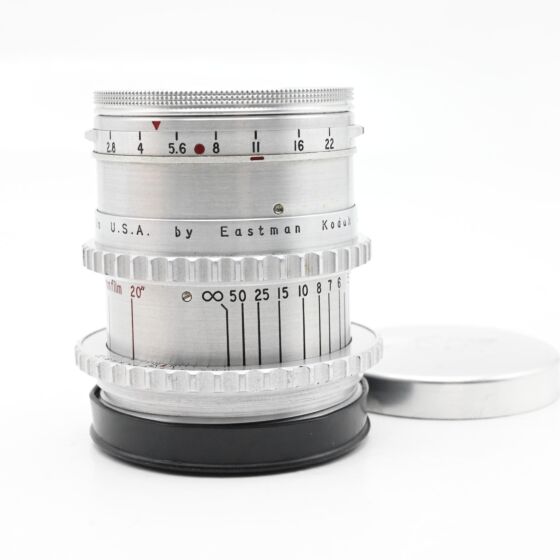
Before Victor Hasselblad built a camera, he sold Kodak's. For years before the war, his family firm was a Kodak dealer in Sweden with close ties to the company's New York office, which is why, when the first Hasselblad finally appeared in October 1948, the glass on the front of it came from Rochester, not Jena or Stuttgart.
The camera was the 1600F, and its standard lens was the Kodak Ektar 80mm f/2.8, supplied by Kodak and, for buyers in the US, fitted before the camera even left the box. It was, by most accounts, a genuinely fine piece of glass. It was also short-lived as Hasselblad's chosen standard. By 1952, with the shutter detuned into the 1000F, Hasselblad had started offering a Zeiss Tessar 80mm alongside it, and within a few years the Kodak lens was gone from the lineup entirely, replaced by the Zeiss glass that would define the brand for the next seven decades.
The official explanation is unglamorous: cost. With Germany's optics industry back on its feet after the war, Zeiss could undercut Kodak, and Hasselblad, still a small company fighting an unreliable shutter, needed to save money wherever it could. One longtime collector, discussing the swap on a photography forum, put it plainly, saying Hasselblad switched to Zeiss because the Kodak lenses had become too expensive.
What's less settled is whether Kodak lost on merit. That same collector had picked up an early Zeiss Tessar for his 1000F and ran it against his Ektar in a direct test. His verdict was blunt: the Zeiss lost badly. It's a single tester's account, not a peer-reviewed study, and lens variation across seven-decade-old optics is real. But it's a real account from someone who owned and serviced both, and it complicates the tidy story where Zeiss simply arrived and was obviously superior.
Even the Ektar's own identity is oddly unresolved. Collectors who've had the lens apart still argue over whether it's built as a Tessar-type, four elements in three groups, or a Heliar-type with an extra element, a design Kodak used elsewhere under the Ektar name for lenses like the Medalist's 100mm. Some examples reportedly turn up as one, some as the other, and nobody selling a decades-old lens with an interior nobody's photographed in years is fully sure which is on the bench in front of them. Kodak's own record-keeping on which formula went into which serial run appears to be lost, if it was ever centralized at all.
What isn't in dispute is which name won the argument that mattered: the one on the box. Hasselblad and Zeiss became one of the closest pairings in camera history, a partnership that camera historians trace directly back to that 1952 switch. Kodak's role as the original supplier faded into a footnote, remembered mainly by people restoring 1600F and 1000F bodies for parts.
Those bodies are the last complication. Functional 1600F cameras are scarce today because the focal-plane shutter that made the model famous was also its weak point, and the 1000F's shutter stayed delicate enough that many photographers avoided it too. So the rematch anyone would actually want, Kodak against Zeiss, on the same mount, both shutters behaving, is one that's getting harder to run with every passing decade. The lens that may have lost the argument is still here. The camera that would let you settle it, less so.