Point a Geiger counter at the right old Voigtländer and it clicks. One collector who tested his own lenses by serial number found a copy made in January 1964 still radioactive decades later, while one made in August 1966 read clean, meaning the factory quietly swapped its glass formula sometime in those two years.
The lenses in question are the original Apo-Lanthars, and the name tells you exactly what was in them. Tronnier, the optical designer behind several of Voigtländer's best postwar lenses, reworked the Heliar formula around 1949 using a new lanthanum-based glass, and the result was deliberately not sold as a Heliar at all — the old design's residual flaws had become part of its character, and this one had none, so it needed a name of its own. Voigtländer introduced it in 1954 as the Apo-Lanthar and kept making it until 1972, marketing it as the first lens of its kind corrected for three colors instead of two. The front element was ground from lanthanum crown glass, which is where half the name comes from, and the barrel carried three painted stripes in red, green and blue to advertise exactly that correction.
The other half of the name is the part nobody put on the barrel. Lanthanum-doped glass often came mixed with thorium dioxide, because thoriated glass has a high refractive index and low dispersion, which is precisely what you want if you're trying to bend all three colors to the same focus point. It also happens to be radioactive. Every lens house doing serious apochromatic work in that era reached for the same trick, and the whole category of rare-earth optical glass largely disappeared from consumer manufacturing by the early 1980s, once the people grinding it for a living raised the obvious objection.
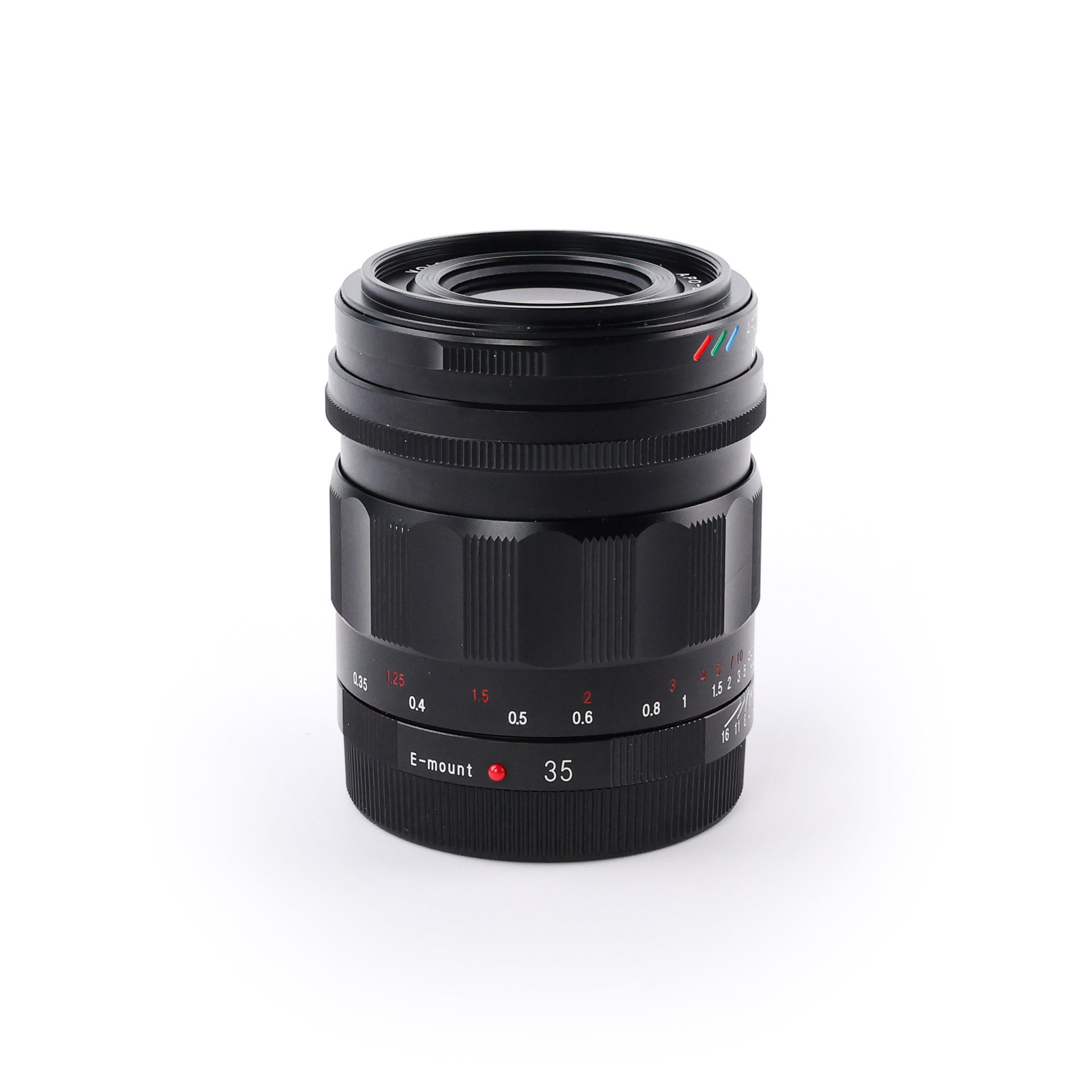
Cosina picked up the Voigtländer name under license in 1999, and it has since applied the Apo-Lanthar badge to exactly one thing: the top of whatever lineup it happens to be attached to. The company's own line is that the designation only goes on its highest-performing lenses. The modern standard-prime lineup started with a 50mm f/2 for Sony's E-mount in 2019 — a few years after Cosina had already revived the Apo-Lanthar badge on E-mount macro lenses like the 65mm f/2 — and the 35mm f/2 followed two years later, announced for both Leica-style rangefinders and mirrorless E-mount at once — eleven elements in nine groups, five of them low-dispersion glass, built around the same target the 1954 lens chased: axial color error in red, green and blue pushed as close to zero as the design allows.
None of it uses lanthanum for the reason the name implies. No thorium, no measurable radioactivity, nothing a customs agent's Geiger counter would ever notice. What Cosina kept was the badge — a modern reviewer of the 50mm version called the RGB rings near the front element a tribute to the original design, which is a polite way of saying the lens wears a warning label for a hazard it no longer contains.
The copy sitting at National Camera Exchange right now, in Sony FE mount, priced at $549.99, has never been anywhere near a reactor. It just carries the name of a lens that had to be.