On April 12, 2005, Kyocera announced it was done making cameras, full stop. Every Contax-branded body, lens and accessory would stop shipping that September. Every one, that is, except one. The press release carved out a single exception: the Contax 645 system got a stay of execution out to December, a few extra months of life while everything else in the lineup went dark immediately.
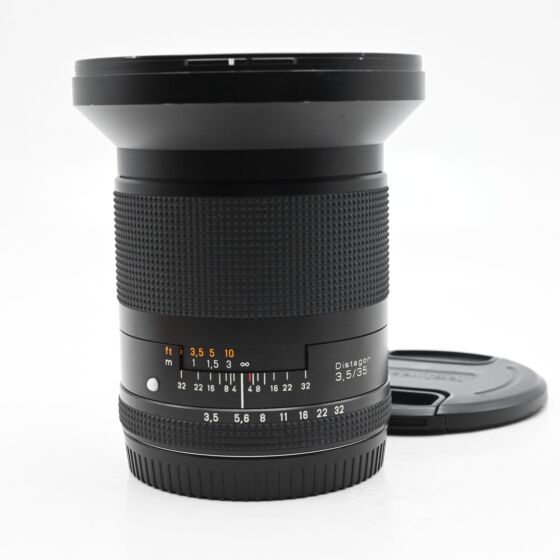
It wasn't much of a reprieve. The Contax 645 AF had only been on sale since February 1999, aimed at the wedding and portrait photographers who wanted medium-format quality in a body that handled like a 35mm SLR, going up against the Pentax 645N and the Mamiya 645 AF. Six years is not a long run for a system built around a full set of Zeiss optics. The 35mm f/3.5 Distagon was the widest of those optics, the super-wide option in the lineup, delivering an angle of view on the 645 frame roughly equivalent to a 21mm lens on 35mm film. Zeiss's own data sheet did not undersell it: the maximum aperture, it claimed, was second to no other super-wide lens in medium format, pitched at landscape, architectural and industrial photographers who needed even corner-to-corner light and well-controlled distortion.
Then the mount it was built for stopped existing. Kyocera's statement blamed difficulty keeping up with rapid market changes, and that was that. Carl Zeiss still owns the Contax name, but no Contax camera has been made since, and the brand is generally considered dormant. The 35mm Distagon went on being a very good lens with nowhere new to go, mounted on secondhand bodies, serviced for a while under Kyocera's ten-year parts commitment, and then not.
What brought it back wasn't nostalgia. It was a Fuji medium-format mirrorless camera that didn't exist when the lens was designed. The GFX system gave orphaned Contax 645 glass something it hadn't had in over a decade: a digital sensor the right size to use it properly, no cropping, no awkward adapter vignetting. A company called Fringer built a smart adapter with full electronic contact between lens and body, enabling autofocus for a short list of Contax 645 lenses that happens to include this one, alongside the 45mm, 80mm and 140mm. Phase-detection autofocus on the newer GFX bodies, contrast-detect on the older ones. Fuji's own wide native glass for the system is expensive, and a twenty-five-year-old Zeiss design, autofocusing again through firmware updated over a USB port, has quietly become the answer people reach for instead.
The lens never changed. The adapter is the thing doing all the work, built by a company in Shanghai for a camera system designed in Japan, to resurrect glass made under license from Germany for a mount that died in 2005. None of those four companies ever worked together on purpose. The Distagon just happened to be good enough, and still exist in enough numbers, that somebody eventually built the bridge back to it.