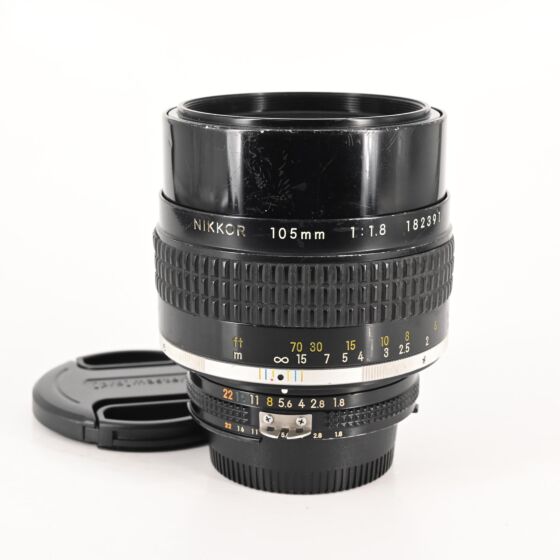
If you mention a vintage Nikon 105mm to a collector, they'll probably think of the f/2.5 — the lens that shot Steve McCurry's famous 'Afghan Girl' portrait for National Geographic. That's a different lens entirely. The one in front of you, the AI-S 105mm f/1.8, is its stranger, faster, rarer sibling — released in 1981 as what one reviewer calls a direct sequel to Nikon's most famous lens, almost a full stop brighter and, by most accounts, without giving up much of anything optically to get there.
What makes the f/1.8 genuinely remarkable is what's not in it. Nikon squeezed that big aperture out of just five elements in five groups, using a Xenotar-type design rather than the more common Gauss-type layout that would typically have needed seven elements to do the same job. Nikon's own official retrospective on the lens credits optical designer Teruyoshi Tsunashima with the achievement, placing him alongside other designers who defined what the company calls the golden age of Nikkor lenses. It was, at launch, the fastest 105mm lens available for photographers, a title it held for roughly three and a half decades until Nikon's own AF-S 105mm f/1.4E arrived in 2016 — and that later lens' own design brief explicitly traced its lineage back to this one.
It was also built as a companion to the 85mm f/1.4 AI-S, both released to accompany the new Nikon F3 body that had launched a year earlier — which is why the two share such a similar look and the same fat, hood-integrated barrel. But where the 85mm and the 105mm f/2.5 became icons, the f/1.8 quietly slipped into obscurity. It was made in far smaller numbers than the f/2.5 — some lens histories cite figures in the tens of thousands against several hundred thousand for its famous sibling, though exact production totals vary by source — never a hot seller, always in the shadow. Sources even disagree on exactly how long it stayed in the catalog, with some lens histories and retailer catalogs listing it as remaining available as late as 2005 — a discrepancy nobody seems to have fully resolved.
Optically, it's a lens with real character rather than clinical perfection. Wide open at f/1.8, reviewers consistently note purple fringing and a softness that clears up by f/2.8 and looks genuinely excellent by f/5.6 — the kind of rendering that modern coatings would have engineered away, but which gives it a distinct, slightly romantic look wide open. Nikon's own technical writeup on the lens argues its balance of sharpness and bokeh remains well suited to the digital age even now. It kept the all-metal AI-S build standard, a built-in lens hood, and a 62mm filter thread, and — crucially for anyone shooting it on modern Nikon DSLRs — its AI-S mechanical indexing still allows accurate metering with non-CPU lens data entry.
That's really why collectors circle back to it. It's a genuine piece of Nikon's optical-design history, a technically ambitious lens built to a strict five-element brief, made in far smaller numbers than its famous sibling, and — because it never picked up the McCurry cachet — it has reportedly traded for less than clean copies of the f/2.5 despite doing more, aperture-wise. A clean example at a real discount isn't just a bargain; it's a quietly significant piece of Nikkor engineering that most people walk past without a second look.