Here's the thing about the Apo Artar that trips people up: it wasn't designed to take pretty pictures. It was designed to make printing plates. The lens traces back to a four-element "dialyte" design that Emil von Hoegh brought to the Goerz optical works in Berlin, and Goerz engineer Walter Zschokke turned it into the Apochromatic Artar, a lens Kingslake's history credits as becoming the most widely used process lens for decades. Its whole reason for existing was three-color separation work for the graphic arts trade — the unglamorous but exacting business of photographing artwork for print reproduction, where color fidelity and flatness across the field mattered more than anything else.
That industrial pedigree is exactly why photographers love it. A true apochromat corrects color fringing far more rigorously than an ordinary lens, and because the Artar's dialyte formula was optimized for tight, controlled corrections, it holds up beautifully even outside its original 1:1 copying job — it performs very well at infinity, with only a touch of corner coma that disappears once you stop down a couple of stops. Optimum performance sits around f/22, and the coverage is famously modest by design standards — roughly 46 to 48 degrees, considerably tighter than a wide-coverage design like the Dagor — but within that circle, the sharpness and low distortion are the whole point. It's a specialist's lens: small, simple, unglamorous, and ferociously good at the one thing it was built to do.
The corporate history is its own small odyssey. Goerz's American assets eventually passed to Kollmorgen around the turn of the 1970s — accounts vary on the exact year — and Schneider picked up the rights not long after: by 1973, the newly formed Schneider Corporation of America had acquired the old CP Goerz Optical Company in Pittsburgh, gaining the manufacturing and sales rights to the Artar and Dagor names. Schneider initially had the Swiss firm Kern build the lenses before bringing production in-house, and — in a detail that surprises a lot of people — the Apo Artar was never multicoated, even in its final years; it stayed a single-coated design right through the end of production, which most sources place in the late 1980s or around 1990.
The photographer connection here is real, if a bit less specific than legend suggests: Morley Baer, the acclaimed large-format landscape and architectural photographer who ran in the same California circles as Ansel Adams and Edward Weston, is remembered by fellow large-format shooters and gear historians as an Artar user. The details of exactly which focal length he favored and how much of his celebrated 8x10 work was in color are less well documented than forum lore sometimes implies, so take the specifics as plausible but not fully nailed down.
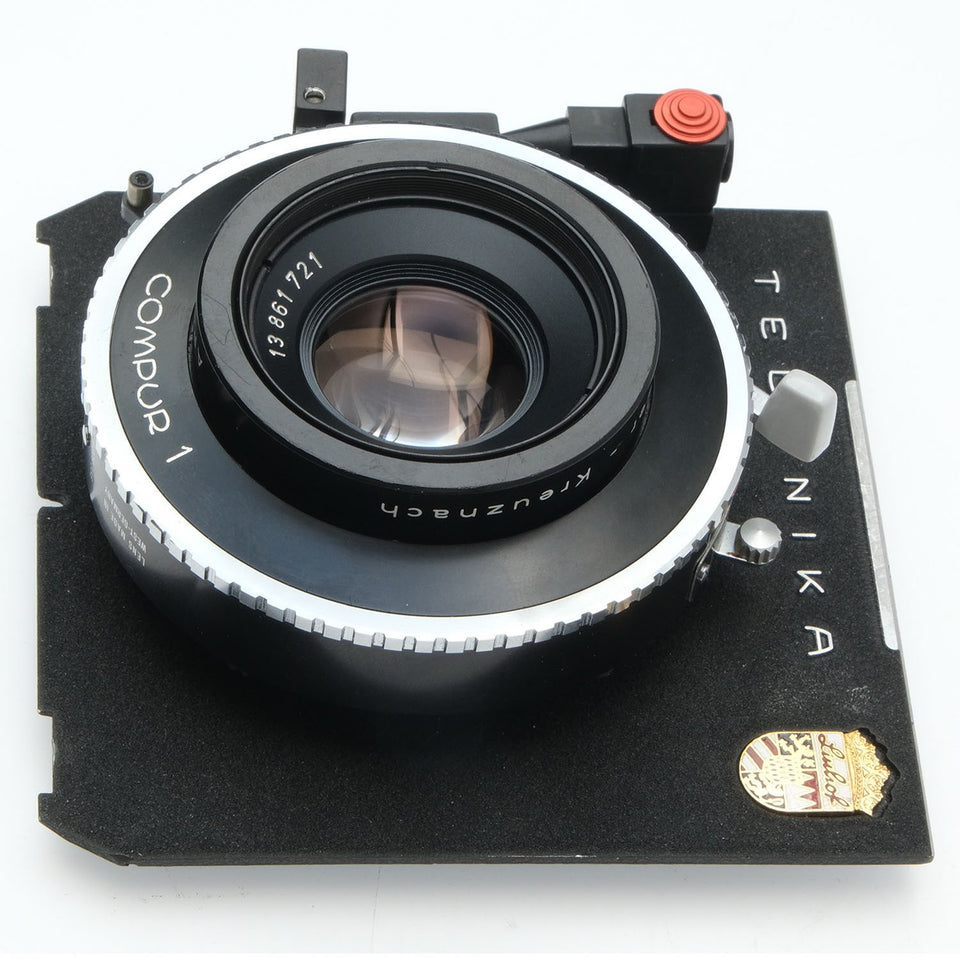
Which brings us to this particular lens: a 210mm f/9 in Compur shutter, the modest, human-sized member of the Artar family — this exact specimen covers 4x5