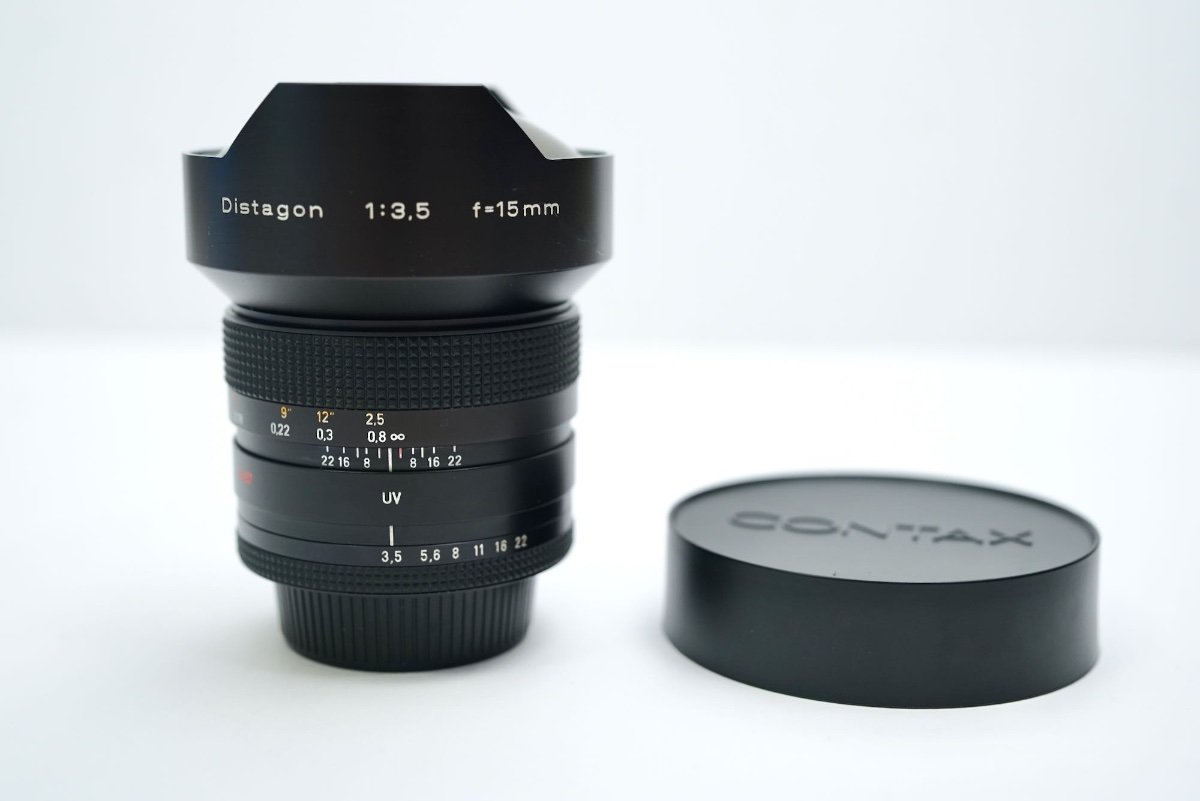
Every so often a listing shows up that makes you sit up a little straighter, and a clean VG-condition Contax 15mm f/3.5 for $1,099 is one of those. This isn't a lens most collectors stumble into casually — it's a specialist's ultra-wide that spent decades as one of the odder corners of the Zeiss catalog, and it's aging into cult status precisely because so few people ever really understood what they were looking at.
The lens traces back further than its Contax badge suggests. According to Zeiss's own historical documentation, the optical design was based on a lens built for the Contarex system — released in 1972 in a tiny experimental batch of only two prototype lenses before Contarex itself collapsed. When Zeiss (West Germany) partnered with Yashica (Japan) in the mid-1970s to launch the new Contax RTS system and its C/Y bayonet mount, that orphaned Contarex design got a second life as the 15mm f/3.5 Distagon, one of the RTS system's launch-era retrofocal super-wides alongside the 16mm f/2.8 and 18mm f/4. Zeiss's own literature from the period pitched the 110-degree lens for interiors, architecture, and "model pictures which sometimes convey a better spatial impression of the construction project than the model itself" — a very 1970s way of describing what we'd now just call real estate and architectural photography.
What makes it technically interesting isn't just the width — it's that Zeiss built it as a true rectilinear design rather than a fisheye, using a floating-element system to hold up optical performance at a punishingly close 0.16m minimum focus distance. Ultra-wide rectilinear lenses that stay sharp and low-distortion at the edges are hard to engineer even now; doing it in the mid-1970s, wide open at f/3.5, was genuinely ambitious. One lens-testing outfit that rehouses vintage glass for cinema use has noted the 15mm shares its optical formula with the Leica Super-Elmar 15mm f/3.5, just with different coatings — worth taking as a well-sourced but still secondhand claim rather than settled fact, though it tracks with how small the pool of ultra-wide rectilinear designs from that era really was.
Rarity is where this lens earns its keep as a collectible. Zeiss made both German-made (AEG) and later Japanese-made (AEJ) versions as production shifted from Oberkochen to Zeiss's Oume facility, and collectors have long paid a premium for the earlier German glass. As for scarcity — Contax didn't even bother building a native 21mm f/2.8 for the C/Y mount until 1994, which tells you how thin the ultra-wide lineup stayed for most of the system's life; the 15mm f/3.5 was, for two decades, about as wide as a Contax shooter could rectilinearly go. One enthusiast blog citing the RedUser "Contax Survival Guide" claims the lens carried an eye-watering ~$11,000 original list price — a figure that should be read as reported rather than independently verified, but it lines up with how expensive and low-volume this thing clearly was even by Zeiss's own standards.
That scarcity is exactly why $1,099 for a VG copy is worth noticing. Recent completed and active listings for AEG- and AEJ-marked copies routinely land in the $1,050–$1,400 range depending on condition and cosmetic haze, with clean examples pushing toward $1,300–1,400. A verified-condition copy at $1,099 isn't a steal in the "too good to be true" sense, but it's a genuinely fair entry point into a lens that mirrorless shooters have started rediscovering for its clean rectilinear rendering and surprisingly modern wide-open performance — the rare vintage ultra-wide that doesn't need an apology alongside it.