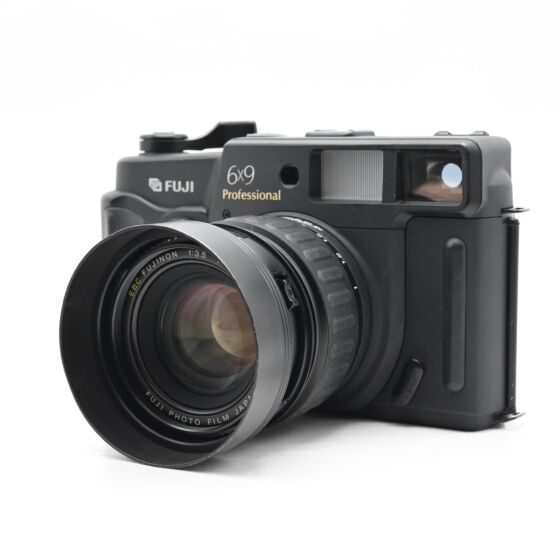
The first thing anyone tells you about the Fujifilm GW690III is the nickname: the "Texas Leica." It's not a marketing coinage — it stuck because the camera genuinely looks like a black Leica M3 that got left in the dryer too long, with a lens the size of a coffee can bolted to the front. Camera-wiki describes it as looking "as if a black Leica M3 with a particularly large lens... had been made to a much larger scale," and once you've seen one next to an actual Leica M6, the comparison is hard to shake.
The lineage goes back further than most people realize. The whole family descends from the Fujica G690 of 1968, an interchangeable-lens medium-format rangefinder. According to camera-wiki's account, Fuji noticed that sales of interchangeable lenses other than the 65mm and 100mm options were weak, and the series eventually simplified into the fixed-lens Fujica GW690 Professional with a 90mm f/3.5 lens. The design barely changed through minor revisions until the GW690III arrived, released in Japan in February 1992 for ¥179,000, targeted to professionals, travel photographers, and landscape shooters, according to Japan Camera Hunter's review. It reportedly stayed in Fuji's catalog well into the 2000s before medium-format film cameras of this type largely disappeared from production lineups.
What makes it more than a novelty is the negative it produces. This is a 6x9cm rangefinder — the largest standard frame size you can get on ordinary 120 roll film, roughly five times the area of a 35mm frame, though you only get eight exposures per roll for the privilege. There's no meter, no battery, no automation of any kind: focus, aperture, and shutter speed are the primary controls, and the mechanical leaf shutter fires fine with a dead battery or none at all. Reviewers consistently single out the EBC Fujinon 90mm f/3.5 lens itself as the real star, and Japan Camera Hunter's review calls it a camera people had heard "whispers" about for its "legendary lens" long before trying one.
The photographer connection worth mentioning — because it's specific and traceable rather than folklore — comes from Japan Camera Hunter, which reports that German portrait photographer Martin Schoeller shot an entire series of portraits on the GW690III, calling it his favorite camera and saying he owned five of them. This isn't just a single-source anecdote: a PetaPixel interview with Schoeller himself independently backs it up, with him saying the Fuji 6x9 with the 90mm lens is his all-time favorite camera and confirming he owned five.
As for the money: this isn't a camera you find for pocket change anymore. One camera-review blog tracking the closely related GSW690III noted that used prices have "really shot through the roof," running roughly $1,000–$1,350 depending on condition as of early 2026, and current eBay listings for the GW690III cluster in a similar range. Against that backdrop, $1,168.58 (Glass Hound find) for a clean GW690III isn't a bargain-bin steal — but it's squarely in line with where this cult classic actually trades, for a camera whose mechanical simplicity, oversized negative, and increasingly scarce clean examples give it real staying power as a hold rather than a flip.
I wast personally considering getting this one - but someone else made the decision faster!