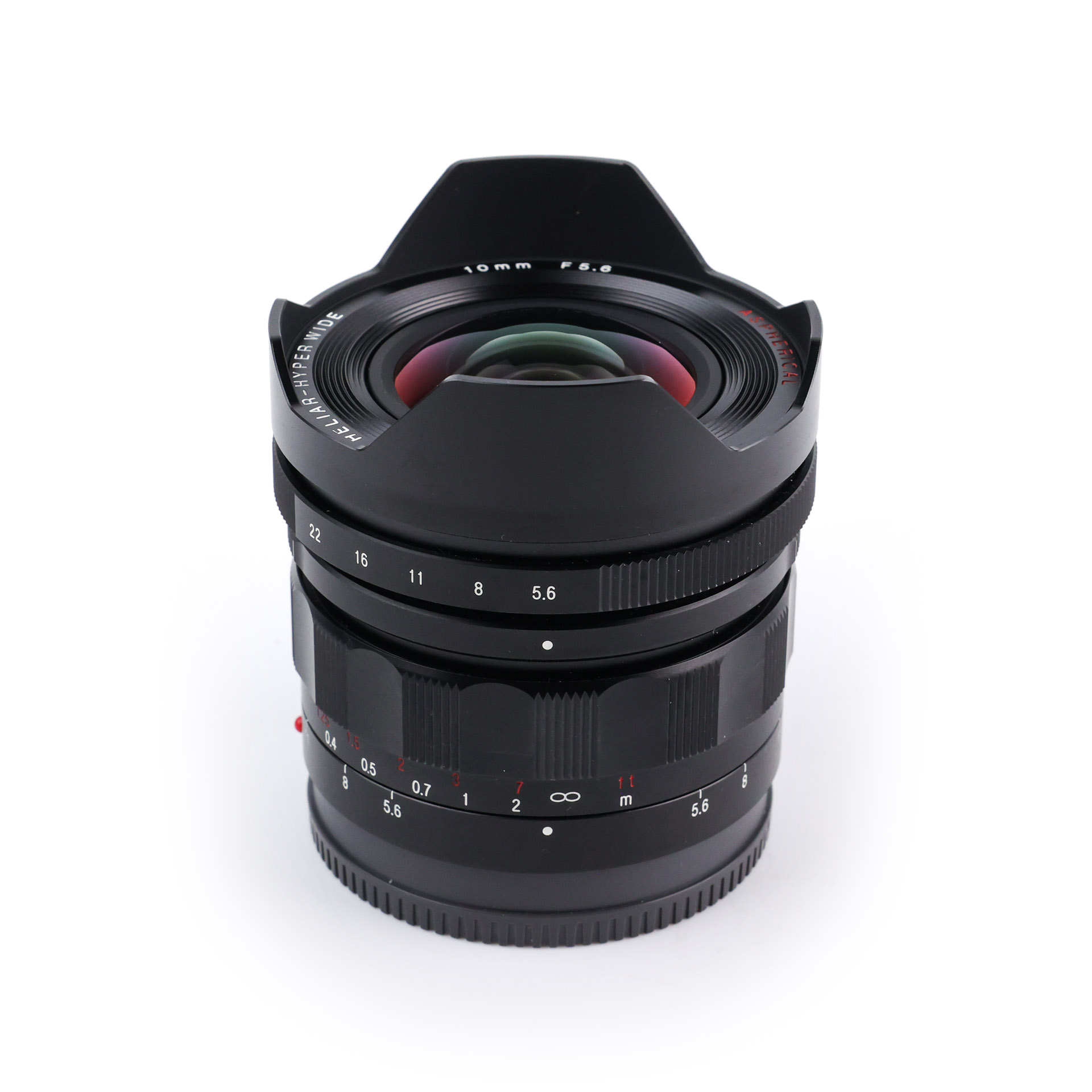
Scroll through owner reviews of the Voigtländer 10mm f/5.6 Hyper Wide Heliar and you keep running into the same warning. A buyer on Adorama puts it plainly: you will need to be careful not to get bits of yourself into images. Nobody warns you about your feet when they sell you a wide-angle lens. This one earns the warning.
The reason is in the number. Cosina brought the lens out under the Voigtländer name in 2015, pitched above the existing 12mm and 15mm Heliars as the widest rectilinear, non-fisheye lens ever built to cover a full-frame image circle — a 130-degree diagonal angle of view without the bowed lines of a fisheye. That figure sits close to the roughly 138-degree angle of view of human peripheral vision, which sounds like poetry: a lens that finally sees the way you do. It isn't that simple. One hands-on reviewer framed the paradox exactly right: you might say it sees things the way we do, but it isn't that simple. A straight line stays straight edge to edge in a way your eye's smeared, curved periphery never does, and that fidelity is precisely what makes the result feel alien rather than natural. Keep the camera off level and those dead-straight lines tip violently — enough that sellers of the lens explicitly recommend using a level to avoid distorted verticals.
Handling it only sharpens the discipline it demands. It's small for what it does, all metal, with a focus ring users compare to the feel of a quality pre-digital lens and an aperture ring that can be de-clicked entirely for video work. There's no filter thread; the front element bulges too far for one. The depth-of-field scale is nearly useless because everything from a few feet out sits in focus simultaneously, and one long-term user found the lens near-impossible to fine-focus by eye even at close range, because everything renders so small in the viewfinder that the hyperfocal markings become the only tool worth trusting. So you frame by habit rather than by what you see through the glass, and level the camera by feel, and only then discover what's actually in the corners.
What's in the corners, reviewers agree, isn't perfect. Edge softness, real chromatic aberration, heavy vignetting, correctable in post but never quite gone. None of it seems to bother the people who own one. It sells at f/5.6 only, manual focus only, manual aperture only, into a market where autofocus zooms cover nearly the same ground at similar or lower prices. Nobody buys this lens because it's convenient.
They buy it because a lens built to match the width of human sight turns out to demand more attention to the frame than any lens you've used, not less. It gives you almost everything in front of you. It also gives you your feet, if you're not paying attention.