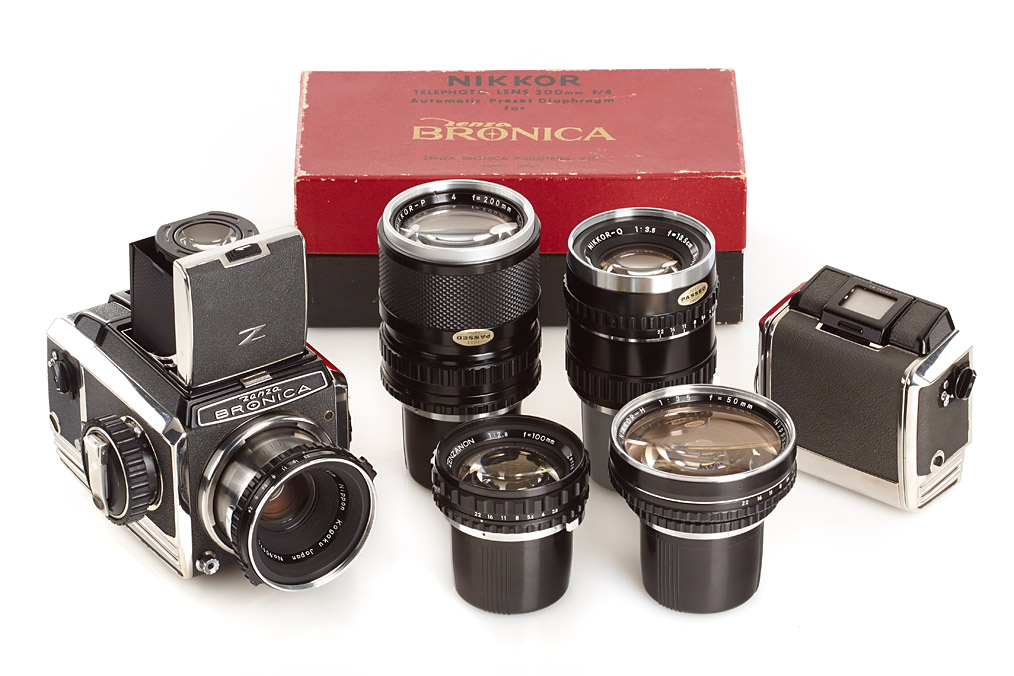
In May 2013, a Zenza Bronica S2 outfit came up in Vienna with an estimate of €800 to €1,000. It is a Japanese medium-format system from the 1960s — competent, well made, and not rare.
Nobody bid.
Six months later the same outfit was back in the same rooms, carrying the same estimate. The house had not changed its mind about what the thing was worth.
The room had. It sold for €552.
That is fifty-five per cent of what it had been valued at half a year earlier, by the people whose job it is to know.
How often lots fail
Leitz Photographica has offered 23,157 lots since 2005 that we can date. 19,013 of them sold. 4,016 found no buyer at all — a sell-through rate of 82%. (A further handful changed hands for a nominal sum, which we count as neither.)
That is a good result by auction standards, and it is worth saying so. Roughly one lot in six going unsold is normal, healthy, unremarkable.
What happens to those 4,016 is the part nobody publishes.
Most of them simply vanish
We can trace an object across sales when it carries a serial number and comes back described the same way. Of the 4,016 failures, we can find 96 that returned to Vienna and sold.
Ninety-six out of four thousand.
The rest leave no trace in the record. Some went home. Some sold privately in the weeks after, which is standard practice and rarely announced. Some went to other houses, or to dealers, or into the drawer they came out of.
A caution about that number. It is a floor, not a census. Our tracing depends on the catalogue recording a serial number and describing the object consistently, and plenty of lots meet neither condition. Some returns are certainly invisible to us. But even allowing generously for those, the shape holds: coming back is the exception, not the routine.
What happens to the ones that do come back
For 95 of those 96 we have the estimate both times. The pattern is consistent enough to be uncomfortable.
| Lots | |
|---|---|
| Estimate cut before the second attempt | 64 |
| Estimate unchanged | 29 |
| Estimate raised | 2 |
The median cut takes the estimate to 80% of the original — a fifth off.
And the outcome:
| Lots | |
|---|---|
| Sold below the estimate it first failed to reach | 85 |
| Sold at or above it | 10 |
The median re-offered lot made 53% of the estimate it originally missed. Barely half.
The typical wait was 546 days. Not the next sale. The one after that.
What that means if it is your camera
The uncomfortable reading is the straightforward one. A lot that fails has not been unlucky in the room. It has been priced wrong, and the house — which set that price — comes to the same conclusion and marks it down.
Waiting does not fix it. Eighteen months later, with a smaller number on it, the same object sells for about half what it first asked.
There are exceptions, and they are worth knowing. A Canon VT that failed at €500–600 came back and made €840. A black paint Leica M4 that missed at €2,000–2,500 returned and took €2,640. Roughly one in ten does better the second time.
But nine in ten do not, and the median is 53%.
The question underneath
There is a larger question in these numbers, and it deserves its own piece rather than a paragraph here.
If a failed lot reliably sells for half its original estimate, and if the house cuts that estimate by a fifth before trying again, then the first estimate was not a prediction. It was a hope.
We have 21,831 Leitz lots where both the estimate and the result are recorded. That is a large enough sample to ask how good the house actually is at valuing what passes through it.
We will.